Sony LED Wall and Spatial Display Pair Up for Climate Installation
2026-11-23 · via AV Magazine
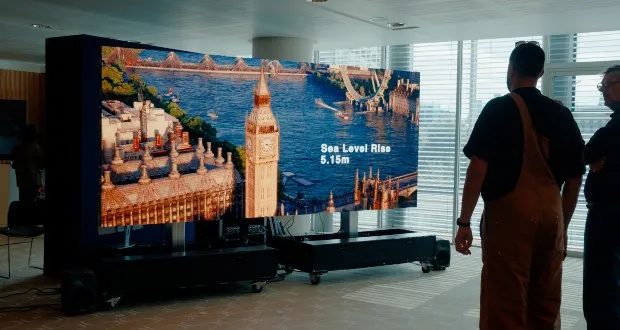
Norwich University of the Arts worked with Sony to install a large-format LED wall alongside a glasses-free 3D display at London's Southbank Centre, pairing two different display technologies to show the same subject matter in different ways. The installation, part of the inaugural Creative Intelligence Festival, visualised 400 years of rising sea levels and projected how familiar London landmarks could be submerged within a century.
For operators evaluating large format LED for experiential or cultural installations, the project is a useful reference point on how Sony positions its Crystal LED line against fine-pitch competitors from the likes of Samsung and LG for public-facing, high-traffic environments. The wall used here was a Verona Crystal LED configuration measuring 9m by 4m, built from 140 panels and delivering 6.7 million pixels, according to the release. That is a sizeable canvas, and the kind of install that trade and architectural audiences will look to as a benchmark for resolution and scale in a one-off public exhibition rather than a permanent retail or transit deployment.
The second piece of kit, Sony's XYN Spatial Reality Display, offered what the companies describe as an intimate, individual viewing experience of the same 3D scenes, viewable without a headset or handheld controller. Pairing a shared large-scale wall with a personal glasses-free 3D screen is a format choice worth noting: it suggests an emerging template for museums, brand experiences and visitor centres that want both a communal moment and closer individual exploration from the same content set, without resorting to VR headsets that require staffing and sanitising overhead.
On the content side, the 3D scenes were built using single-camera photogrammetry, Google Earth data and Gaussian splatting, a production pipeline that is becoming more common for location-based 3D visualisation work. The announcement does not say what media player or content management system drove playback across the two displays, nor does it give a cost or say how long the installation ran at Southbank Centre.
Norwich University of the Arts says it is exploring a portable version of the setup for future exhibitions and public engagement, which would be the more relevant development for signage and AV integrators watching this space. A one-off festival install built around a 9m LED wall is not something most venues can replicate, but a touring or modular version using smaller Crystal LED configurations and the Spatial Reality Display could be more directly applicable to museums, corporate lobbies and education settings looking to commission similar science or climate communication pieces. Further details on that portable format have not been announced.
The announcement in full
Reproduced from AV Magazine for reference. Digital Signage Magazine did not write the text below.
By AV Magazine in Displays , UK&I November 23, 2026 0
Norwich University of the Arts and Sony used a 9m x 4m Verona Crystal LED wall and a Spatial Reality Display to turn research into an immersive experience at London’s Southbank Centre.
Norwich University of the Arts collaborated with Sony to bring the long-term impact of rising sea levels into focus through an immersive installation at London’s Southbank Centre.
The installation at the inaugural Creative Intelligence Festival was designed to communicate climate change across a long timeframe in a format that audiences could understand quickly and connect with emotionally.
Combining a 9m by 4m Verona Crystal LED display with Sony’s glasses-free Spatial Reality Display, the project presented two complementary ways to experience a changing London.
Large-scale city imagery offered a shared viewing experience, while detailed 3D scenes invited visitors to explore the visualisation more closely, without a headset or handheld controller.
It translated a 400-year cycle in rising sea levels into a concise animation, showing how familiar landmarks could become submerged within 100 years. By making a distant environmental challenge feel immediate, the project aimed to encourage reflection on the need for action today.
The two presentation formats balanced the impact of a large-scale installation with individual exploration. Together, they helped move the climate narrative beyond technical information and into an experience audiences could engage with directly.
The Verona Crystal LED video wall comprised 140 panels displaying cinematic imagery across 6.7 million pixels, while the XYN Spatial Reality Display offered a more intimate encounter for visitors who could stand in front of the display and look around the 3D scenes.
The 3D scenes of London were created using single-camera photogrammetry, Google Earth data and Gaussian splatting.
Professor Louis Nixon, dean of research and knowledge exchange at Norwich University of the Arts, says: “Through our collaboration with Sony, this project provided an opportunity to explore how cutting-edge visualisation technologies can transform the communication of environmental challenges.
“What impressed me most was the ability of the technology to remove many of the traditional barriers between the viewer and the content.
“Rather than asking an audience to interpret technical information, the displays enabled them to experience it directly, creating a much deeper level of engagement and understanding.”
The university team is exploring opportunities to replicate the set-up for future exhibitions and public engagement, including a portable installation to bring the visualisation to new audiences.