Seoul's Landmark K-POP LIVE Screen Upgraded to 12K Unilumin LED
2026-11-17 · via AV Magazine
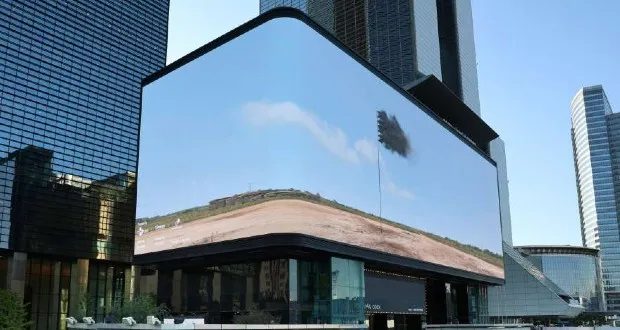
A major DOOH landmark in Seoul has been re-equipped with a new LED system, replacing the Samsung display that had been in place since 2018. CJ CGV's K-POP LIVE screen, a 1,616 square metre curved installation overlooking the COEX K-POP Square, now runs on 2,156 Unilumin Usurface III 6 Pro cabinets, installed by integrator Kinoton.
For operators running large-format landmark displays, the upgrade is a useful benchmark of where high-brightness outdoor LED has moved in the eight years since the original installation. The new screen has a resolution of 12,060 by 3,015 pixels and a pixel pitch of 6.67mm, down from 10mm on the previous system, according to the companies involved. Brightness reaches up to 12,000 nits and the refresh rate is listed at 15,360Hz. A curved section engineered to a 2.29m radius is designed to reduce distortion for 3D and anamorphic content, which is the format this screen is best known for internationally, including Dstrict's Wave installation.
The display is required to run 18 hours a day, every day of the year, according to Kinoton Korea general manager Brooke Lee. That requirement shaped the processing setup: two Analog Way Aquilon C+ units were deployed, one as primary and one as back-up, so that a failure on one side does not take the screen dark. Analog Way says the units were custom configurations rather than off-the-shelf models, built to the specific requirements of the LED system. Each Aquilon C+ supports up to 24 4K60 inputs, 20 4K60 outputs and 24 True 4K scaling layers, with built-in Genlock synchronisation and EDID management to keep output consistent across sources of varying resolution and refresh rate.
The install was also a logistics exercise. The site sits above a busy pedestrian area in central Seoul, which compressed the available installation window. Kinoton says it used Analog Way's Web RCS Emulator to preconfigure and test the processing system remotely ahead of time, cutting onsite setup time by more than half, according to the companies.
Audio for events is handled by a JBL system with Crown amplification, a detail that matters for a screen used for live programming as well as advertising content.
The announcement does not give a cost for the project or a completion date beyond the general timeframe implied by the coverage. It also does not specify who supplied the original Samsung display or why that system was due for replacement, though a pixel pitch reduction of roughly a third and a jump to 12,000 nits suggest the brief was aimed squarely at keeping the screen competitive against newer fine-pitch landmark installations elsewhere in Asia.
Beyond advertising, CJ CGV continues to use the screen for digital art programming, including John Gerrard's Western Flag (Spindletop, Texas) 2017, which the companies cite as an example of the content range the upgraded system is expected to support.
The announcement in full
Reproduced from AV Magazine for reference. Digital Signage Magazine did not write the text below.
By AV Magazine in APAC , Digital Signage and DOOH November 17, 2026 0
Seoul’s 1,616 sq metre, 3D K-POP LIVE screen has been refreshed with 2,156 Unilumin Usurface III 6 Pro LED cabinets, which have a pixel pitch that is a third less than the previous display.
A technology upgrade of a DOOH landmark in South Korea has seen the Samsung installation replaced with a 12K Unilumin LED display.
CJ CGV’s giant, curved 3D screen, K-POP LIVE, which overlooks the COEX K-POP Square, has been one of the centrepieces of Seoul’s digital landscape since its installation in 2018 .
Integrator Kinoton was brought in to replace the existing display with a 1,616 sq metre Unilumin Usurface III 6 Pro system.
The screen has a resolution of 12,060 by 3,015 pixels and a brightness of up to 12,000 nits. A curved section engineered to a 2.29m radius accommodates the display’s geometry, helping minimise distortion when presenting 3D and anamorphic content.
Its 6.67mm pixel pitch, compared with the previous screen’s 10mm specification, provides greater image detail, while the 15,360Hz refresh rate supports smooth image reproduction.
The display comprises 2,156 LED cabinets, with processing and control configured to support continuous operation. Two Analog Way Aquilon C+ processors form the primary and back-up configuration. In addition, an accompanying JBL audio system with Crown amplification provides sound reinforcement for events requiring audio.
Kinoton Korea’s general manager, Brooke Lee, says system stability was a key consideration in the processing architecture.
“From the outset, stability and sustainability were key priorities for the installation, as there can be no black screen and it has to operate 18 hours a day, 365 days a year,” she says. “Due to this, the client wanted a backup system so that if one system failed, another would be ready to take over.”
Felix Chang, Analog Way’s country manager for Korea and Japan, adds: “Two identical Analog Way units were supplied for the project – one configured as the primary processor and the other as back-up.
“These were not off-the-shelf models but custom configurations developed to meet the specific requirements of the LED display and its wider processing system.”
Each Aquilon C+ unit supports up to 24 4K60 inputs, 20 4K60 outputs and 24 True 4K scaling layers. Built-in Genlock frame synchronisation and EDID management help maintain consistent output when integrating sources with different resolutions and refresh rates.
Kinoton used the Analog Way Web RCS Emulator to preconfigure and test the system remotely before installation, reducing onsite setup time by more than 50% and helping the team meet a compressed schedule at a site above a busy pedestrian area.
Beyond commercial advertising, the display also presents digital art, including Western Flag (Spindletop, Texas) 2017 by Irish artist John Gerrard. The work depicts a plume of black smoke rising from an oil field in Texas, highlighting the environmental impact of fossil fuel extraction.
The COEX display has become internationally known for large-scale anamorphic content, including the Wave digital art installation created by Dstrict .