Seeper Builds Unified LED and Projection System for Sunderland Culture House
2026-09-17 · via AV Magazine
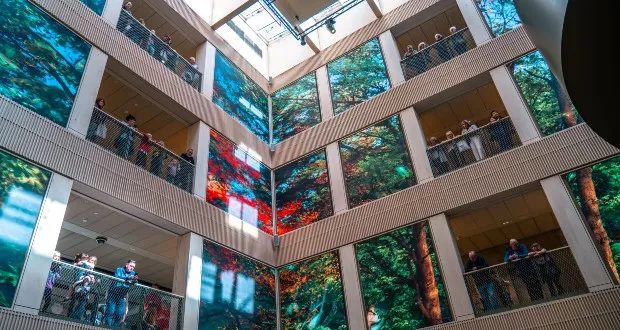
Culture House Sunderland, a new civic and cultural venue in northern England, has opened with an AV system built around a single content platform rather than a collection of separate screens. Spatial storytelling studio Seeper led the design work, and the project offers a useful case study for anyone specifying large-format displays in public buildings: the operator manages an entire building's worth of screens, projection and lighting from one system rather than juggling separate boxes.
According to Seeper, the studio was originally brought in five years ago to advise on AV hardware, but concluded early that the venue needed a unified experience design instead. Managing director Stuart Mckenna says the studio ended up designing "the DNA of a building" rather than installing equipment.
The centrepiece is an atrium LED installation spanning three floors, described by Seeper as more than 12,000 pixels wide, with the building's moving lights cued directly from the content system. Seeper chose DigiLED's Zeus LED platform for the atrium, citing power efficiency as a main driver, which the company says shaped power, racking and cabling decisions to support the building's carbon-neutral target. PureAV handled physical installation and commissioning as Seeper's integration subcontractor, with DigiLED engaged in turn by PureAV.
Three looping content pieces, referred to as "atmospheric worlds" and themed around sea, glass and nature, were built to run for long periods without feeling repetitive or intrusive, according to the announcement. Presence sensors on multimedia bookcases in the atrium trigger local content, including material from Kielder Observatory and theatre companies, as visitors approach.
Projection and interactive spaces
The venue also includes a 360-degree Immersion Gallery, which Seeper describes as its most technically demanding space: a continuous edge-blended image roughly 15,000 pixels wide across eight projectors, paired with a surround-sound system supporting up to 12.1 channels, driven by a dedicated media server.
A separate City Eye area uses large-format touchscreens for a city-history quiz and partner-built interactive content. Wayfinding screens throughout the building share the same content platform and visual language as the atrium and galleries rather than functioning as standalone signage.
Seeper says the whole system sits on a centralised content platform alongside a media-server layer for large-format playback and a show-control layer handling audio, physical controls and safety overrides, letting Culture House staff run everything from the atrium down to individual bookcase screens through one interface.
DigiLED's UK sales manager James Hensman says he expects the project to set a trend for future city libraries. The announcement does not detail ongoing content management workflows, staffing requirements, or costs involved in running the system day to day, details operators considering similar multi-space deployments will likely want before committing to comparable builds.
The announcement in full
Reproduced from AV Magazine for reference. Digital Signage Magazine did not write the text below.
By AV Magazine in Systems design and integration , UK&I , Venues September 17, 2026 0
The spatial storytelling studio linked a vast atrium LED environment, interactive displays, immersive projection and wayfinding into a single visitor journey at the north of England venue.
Spatial storytelling studio Seeper has led the experience design of a culture hub that opened in northern England at the weekend.
Culture House Sunderland is the UK’s National Centre for Creative Smart Cities and home to Sunderland’s City Library. The venue brings together exhibition and heritage spaces, creative technology labs, a 360° Immersion Gallery, podcasting studios, a media studio and a rooftop sky garden.
Seeper was first approached to advise on the building’s AV hardware five years ago. Managing director Stuart Mckenna says: “When we were first asked to help with the AV hardware for this building, it was obvious within minutes that hardware wasn’t the answer.
“Culture House needed an experience – not a set of boxes on a wall. Five years on, we’ve designed the DNA of a building that will outlive all of us, one that will inspire, educate and entertain generations of people who haven’t been born yet. This is exactly the kind of project we set the studio up to do.”
Rather than treating each space as a separate installation, Seeper designed Culture House as one connected environment. Content on the atrium’s large-format screens, the interactive City Eye touchscreens, the Immersion Gallery and wayfinding signage throughout the building draw on a single underlying system, ensuring a visitor’s journey feels like a continuous story, rather than a series of disconnected rooms and exhibits.
The heart of the building is its atrium – a vast LED environment that rises through the full height of the building, spanning three floors and wrapping around the central staircase.
Content plays across an ultra-wide canvas more than 12,000 pixels across, with the building’s moving lights cued directly from the content itself, so light and image act as one composition.
Seeper selected DigiLED’s Zeus system as the LED platform early in the process, driven largely by its power efficiency. This shaped the system design, power, racks and cabling around it from the outset, in support of the building’s carbon-neutral ambition.
PureAV, Seeper’s AV and systems integration subcontractor, carried out the physical installation and commissioning, engaging DigiLED as its own subcontractor for the Zeus system.
Atmospheric worlds Three ‘atmospheric worlds’ of content were created for the atrium, designed to run for long stretches of the day without becoming intrusive. ‘Sea’, inspired by Sunderland’s proximity to the coast, is built on a bioluminescent, waterfall-like effect; ‘glass’, referencing the city’s glass-making heritage, features a slowly shifting cathedral of glass prisms; and ‘nature’, reflecting Sunderland’s environmental ambitions, depicts a hyper-real woodland.
Presence sensors on the atrium’s multimedia bookcases surface video, imagery and stories from local organisations – including Kielder Observatory and theatre companies – as visitors approach.
The atmospheric worlds content plays across the Immersion Gallery – a dedicated projection room wrapping visitors in a four-wall, 360° canvas, with a full-range surround-sound system supporting up to 12.1 channels of spatial audio.
The building’s most technically ambitious space, it wraps visitors in a single continuous image nearly 15,000 pixels wide, edge-blended across eight projectors and driven by a dedicated media server.
The City Eye space offers an interactive digital window onto Sunderland. A wall of large-format touchscreens allows visitors to explore the city’s people, places and stories, test what they know through an interactive quiz, and dive into partner-built experiences.
Rather than being treated as bolted-on signage, wayfinding is built in the same content platform and design language as every other experience in the building, so a directory or welcome screen carries the same visual identity as the atrium and galleries.
Everything is underpinned by a centralised content platform, working alongside a media-server layer for large-format playback and a show-control layer for audio, physical controls and safety overrides.
This allows Culture House’s team to manage everything from the vast atrium visuals down to the smallest bookcase screen from one system.
‘Setting a trend’ DigiLED’s UK sales manager, James Hensman, says: “Culture House Sunderland is a superb blend of analogue and digital. I can imagine this project setting a trend for future city libraries to follow.
“Stepping into the main atrium and seeing our digiTHIN VU Q screens activated with such incredible content is simply breathtaking. Yet they blend beautifully with the calming architecture.
Seeper’s creative director, Chris Brown says: “We felt our job, through experience design, was to give Culture House a soul. A layer that’s as much about sound, light and interaction as it is about what you see on screens.”