Samsung Spatial Signage Deploys Glasses-Free 3D at Tokyo Game Show
2026-09-23 · via AV Magazine
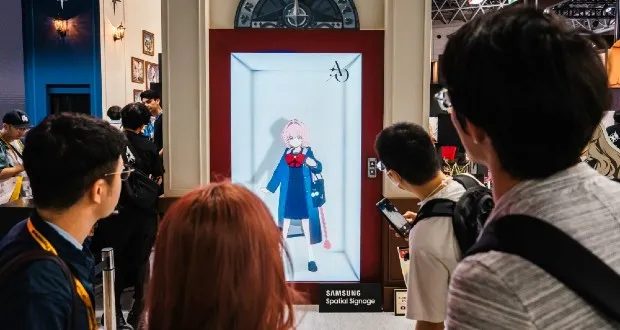
Samsung Electronics used its 3D Spatial Signage displays to bring characters from an upcoming role-playing game into physical space at Tokyo Game Show 2026, giving operators another real-world example of glasses-free 3D signage outside a lab demo.
Games developer NC built an elevator-themed entrance to its booth around an 85-inch Spatial Signage display, using it to introduce characters from its title Astrae Oratio at what Samsung describes as near life-size scale. Smaller 32-inch units were placed in waiting areas to keep visitors engaged with the characters while queuing.
The displays use Samsung's 3D Plate technology, which the company says creates a sense of depth without viewers needing 3D glasses. Samsung says the effect makes the space appear to extend behind the screen, despite a physical profile of 52mm for the 85-inch unit and 49.4mm for the 32-inch model. That thinness is the practical selling point for integrators: a slim, wall-mountable panel that behaves like a volumetric display without the rigging or glasses-based viewing constraints of older 3D signage approaches.
Yongsoo Lee, head of NC's Astrae Oratio business division, said the goal was for visitors to feel they were coming face to face with the characters from the moment they entered the booth, and that the realism of the characters mattered to the effect. Lee also said the slim profile made installation easier and freed up floor space for merchandise storage, a practical detail that will matter more to event and retail operators than the visual gimmick itself.
For anyone speccing out an experiential installation, the case study answers some questions and leaves others open. It confirms Spatial Signage can be integrated into a built structure (the elevator-themed entrance) rather than standing alone, and that it scales down to 32 inches for secondary, high-dwell-time locations like queue lines. It does not say what content pipeline or media player NC used to produce the 3D content, what the near life-size claim translates to in exact screen dimensions relative to viewing distance, or what this deployment cost.
Where this fits
Samsung positions Spatial Signage for entertainment, retail and event environments, and points to a separate deployment at Everland Safari World in South Korea, where the displays are used in an attraction queue. Glasses-free 3D and volumetric-style signage has been a recurring pitch from several manufacturers for experiential retail and entertainment, and gaming conventions are a natural proving ground because they draw exactly the audience willing to stop and look. The Tokyo Game Show installation is a marketing showcase rather than an independent test, so operators evaluating the technology for their own venues will still want details on cost, content authoring requirements and durability that this announcement does not provide.
The announcement in full
Reproduced from AV Magazine for reference. Digital Signage Magazine did not write the text below.
By AV Magazine in APAC , Displays September 23, 2026 0
An 85″ display at the Tokyo Game Show introduced characters from Astrae Oratio at near life-size scale, creating an experience that blurred the line between the digital and physical worlds.
Samsung Electronics’ 3D Spatial Signage was deployed to bring the characters of an upcoming fantasy role-playing game (RPG) into the physical world at the Tokyo Game Show 2026.
The entrance to games developer NC’s booth featured an 85″ Spatial Signage display integrated into an elevator-themed installation, introduced characters from Astrae Oratio near life-size scale.
Featuring Samsung’s 3D Plate technology, the Spatial Signage created a vivid sense of depth without requiring viewers to wear 3D glasses.
Despite its 52mm profile, the Spatial Signage is designed to create the visual impression of depth, making it appear as though the space extends behind the screen.
Beyond the entrance area to the booth, 32″ Spatial Signage displays with a 49.4mm profile were positioned in waiting areas to keep visitors engaged with the game’s characters.
Yongsoo Lee, head of NC’s Astrae Oratio business division, said: “We wanted visitors to come face to face with the characters at life-size scale and feel immersed in the game’s world from the moment they entered the booth.
“The liveliness and realism of the characters was especially important and we believed that Samsung Spatial Signage would make this possible.
“Designing the visitor flow was quite challenging, but since Spatial Signage is very slim, it was easy to install and make effective use of the space. It also gave us room to store merchandise for visitors.”
Samsung Spatial Signage is increasingly being used across entertainment, retail and event environments. Recent deployments include Everland Safari World in South Korea , where it has been integrated into the attraction’s waiting queue.