Samsung's Glasses-Free 3D Signage Moves From Trade Show Gimmick to Live Events
2026-09-24 · via invidis
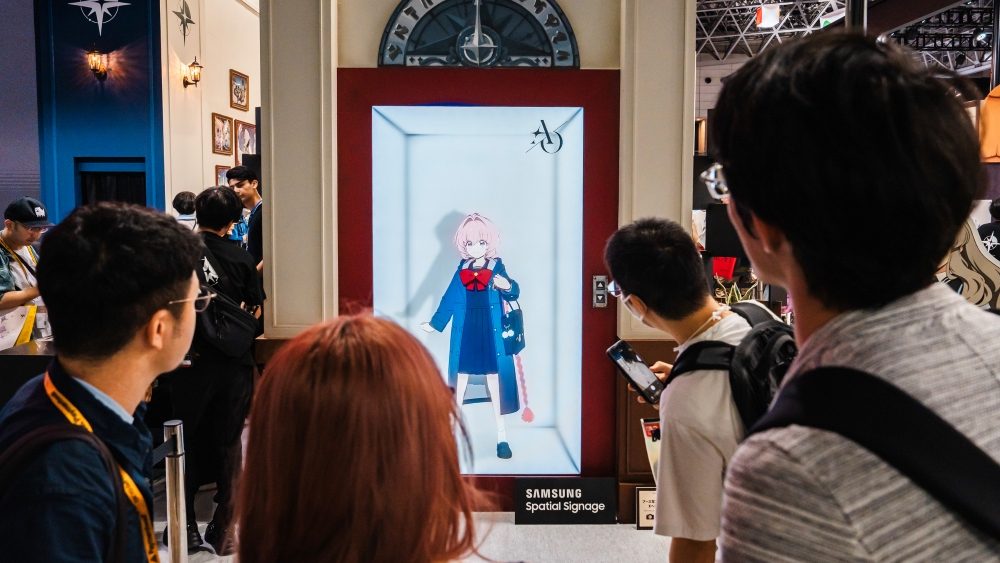
Samsung's glasses-free 3D display technology, branded Spatial Signage, was used by game developer NC at Tokyo Game Show 2026 to build out an entire booth experience around its new title Astrae Oratio, according to a report from invidis. The deployment is worth attention for anyone weighing whether 3D signage has moved past being a trade show curiosity.
For most of the last two decades, 3D signage has struggled to find a commercial home. High costs, thin content pipelines, and the need for special glasses kept it largely confined to showrooms and one-off demos. Samsung's pitch this time, per invidis, is that glasses-free 3D now fits a different job: live events and branded experiences where emotional impact matters more than pure information delivery.
At the NC booth, life-sized game characters greeted visitors in an elevator-themed entrance built around the display technology, with the goal of making characters feel physically present rather than just pictured on a screen. NC also placed multiple 32-inch 3D displays along queue lines and visitor pathways, turning wait time into branded content time rather than dead space.
What this means for queue management
The queue application is the more transferable idea here. Waiting areas at conventions, theme parks, museums and stadiums are usually treated as necessary friction, not engagement opportunities. Samsung's Spatial Signage is described in the report as having a relatively slim depth, which the company says makes it easier to fit into constrained spaces such as queue corridors that double as evacuation routes. The announcement does not specify exact dimensions, so operators working with fire code or egress requirements will need to check that directly with Samsung rather than take it on faith.
For signage operators, the bigger shift is in how success gets measured. Brightness, resolution and screen size have long been the standard specs for evaluating a signage buy. invidis argues that experiential deployments like this one are judged instead on dwell time, social sharing and memorability, with visitor-generated video content extending the campaign well past the event floor. That is a marketing claim rather than a measured result, and the report does not cite any figures for engagement, social reach, or cost at the NC booth.
What is notably absent from the writeup is any detail on pricing, content production timelines, or how the 3D content was authored, though invidis notes that real-time rendering and AI production tools have made 3D content easier to build than in earlier generations. For operators evaluating 3D signage for events rather than retail, the queue-line use case looks like the more practical takeaway than the flagship character installation.
The announcement in full
Reproduced from invidis for reference. Digital Signage Magazine did not write the text below.
For many years, 3D displays were primarily used as eye-catching attractions at trade shows and technology showrooms. Increasingly, however, the technology is finding its way into theme parks, festivals, live events, and branded experiences. 3D displays may finally have found their natural home: the experience economy.
At the Tokyo Game Show 2026 , game developer NC used 3D signage not as a standalone attraction, but as an integral part of the visitor journey surrounding the launch of its new urban fantasy role-playing game Astrae Oratio . Samsung’s Spatial Signage transformed the exhibition booth into a physical extension of the game’s digital universe.
Bringing Digital Characters into the Real World
One of the biggest challenges for game publishers and entertainment brands is translating digital characters into physical environments. Posters, LED walls, and traditional digital signage displays can present content, but they rarely create the impression that characters are genuinely present.
This is where professional 3D displays come into play. Glasses-free 3D technology creates a convincing sense of depth, allowing characters to appear as if they exist behind the display or are stepping out of the screen. At the entrance to NC’s booth, life-sized game characters welcomed visitors within an elaborately designed elevator-themed environment.
The value lies less in the technology itself and more in its emotional impact. Visitors encounter characters almost face-to-face, creating a stronger connection with the content. For entertainment brands, 3D signage becomes a tool for extending storytelling beyond the boundaries of the screen and into the physical world.
You are currently viewing a placeholder content from YouTube . To access the actual content, click the button below. Please note that doing so will share data with third-party providers.
Turning Queues into Part of the Experience
Even more interesting than the entrance installation was the use of 3D displays throughout the visitor journey. Multiple 32-inch displays were installed in queue zones and along visitor pathways. Rather than treating waiting lines as a necessary inconvenience, NC turned them into part of the fan experience.
This highlights a new use case for 3D signage. Whether at gaming conventions, theme parks, museums, or sporting events, visitors increasingly spend time in transitional and waiting areas. These spaces often offer little value in terms of visitor engagement.
3D displays make it possible to integrate characters, stories, and branded content into these areas without requiring additional space or large-scale immersive installations. Samsung’s Spatial Signage is particularly suited to such environments thanks to its relatively slim depth, allowing integration even where space is limited. Queue areas often double as evacuation routes, making every centimetre count.
For years, digital signage projects were primarily evaluated based on brightness, resolution, and screen size. Live experiences demand a different set of metrics: attention, interaction, social media reach, and memorability.
This is precisely where glasses-free 3D signage excels. Visitors stop, engage with the content, record videos, and share them across social platforms. For brands and event organizers, this creates additional value through user-generated content that extends far beyond the event venue itself.
In sectors such as gaming, entertainment, sports, and retail, this effect can be more valuable than simple information delivery.
The digital signage industry has experienced several waves of 3D technology over the past two decades. High costs, limited content ecosystems, and the need for specialized glasses often prevented widespread commercial adoption.
Today’s generation of glasses-free 3D displays benefits from very different market conditions. Brands are investing more heavily in experiential marketing, social media amplification, and visitor engagement. At the same time, game engines, real-time rendering technologies, and AI-powered production tools have dramatically simplified the creation of 3D content.
Perhaps the true sweet spot for 3D signage is not just retail, but environments where emotion, attention, and storytelling matter most: live experiences.
Beyond the Wow Factor : 3D Signage for Live Experiences
InfoComm India : Global Brands Discover India
NSE : Inside India’s LED-Powered Stock Exchange
Forté Appoints Christopher Mounts as Global CEO
ISE 2027 : More Content and a New Day for DSS