Louis Vuitton Hides Hong Kong Store Renovation Behind LED-Wrapped Train Façade
2026-11-23 · via invidis
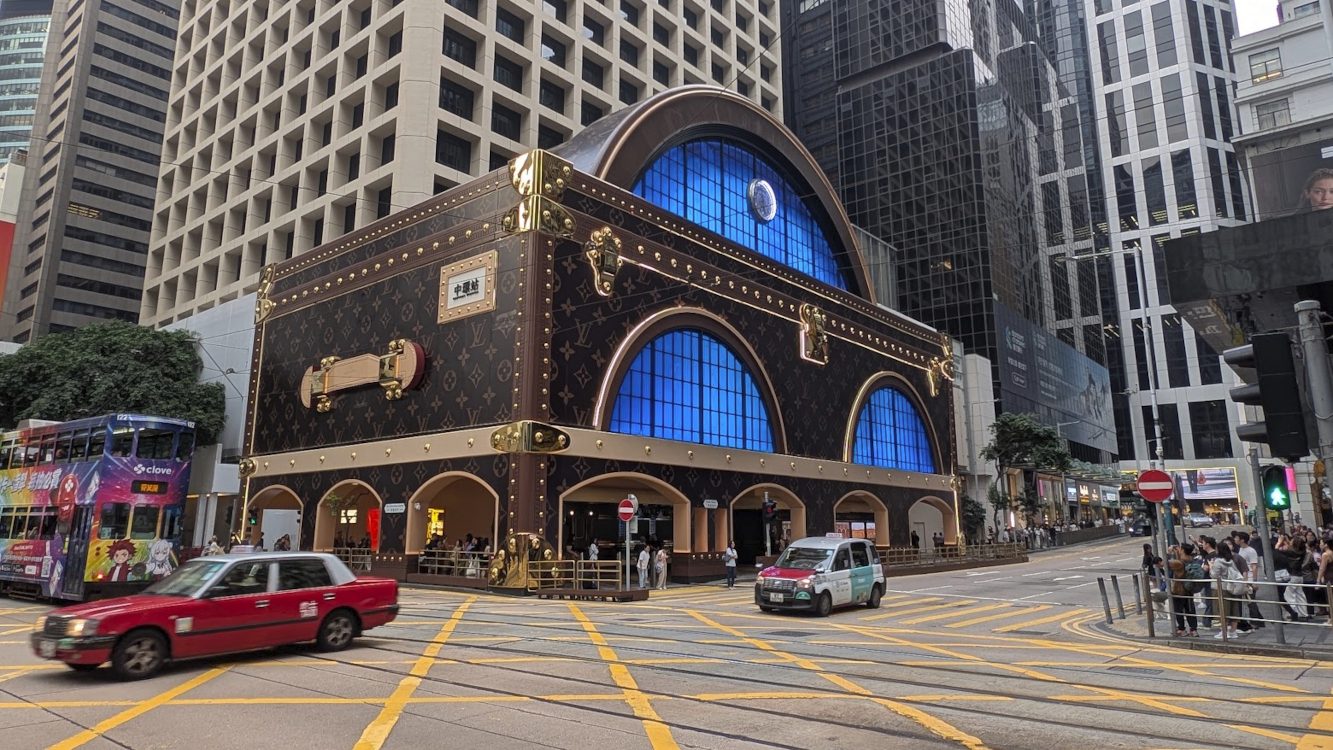
Louis Vuitton has turned the renovation of its Hong Kong Island flagship into a street-level attraction, using LED video walls as the windows of a full-scale fake train installation that wraps the closed store, according to invidis.
The flagship sits along the route of the city's historic double-decker trams and is undergoing a major refurbishment. Instead of standard construction hoarding, Louis Vuitton built a facade styled as a grand railway terminal, with architectural detailing and indirect lighting meant to give it depth beyond a typical site barrier. At street level, a stylized locomotive pulls a line of passenger carriages along the length of the site. The carriage windows are LED video walls running animated brand content, according to the report.
This is not Louis Vuitton's first run at the idea. The brand used a similar approach during the renovation of its Fifth Avenue flagship in New York, wrapping that construction site in the shape of a giant trunk. That installation drew significant social media attention before the store even reopened, and the Hong Kong project appears to follow the same playbook.
Why it matters for screen operators
For people who run digital signage for a living, the detail worth noting is where the LED sits in the hierarchy. The screens are not the headline. The architecture, the theming and the physical scale of the installation do the work of stopping pedestrians and trams full of onlookers. The video walls are used narrowly, as carriage windows showing brand narratives, rather than as a generic ad surface bolted onto a fence.
That is a different brief than most retail media or DOOH deployments, which tend to lead with the screen and the ad inventory. Louis Vuitton's approach treats a closed, non-trading store as an opportunity for sustained brand storytelling rather than a problem to be hidden behind printed hoarding. The report notes that visitors are already gathering to photograph the installation, with the trams passing in front of it as a backdrop.
What the report does not say is anything about the display hardware used, brightness, resolution, pixel pitch, the content management setup behind the animated windows, or the cost and duration of the installation. There is also no detail on how long the facade will remain up or when the renovated store is expected to reopen. For operators and integrators, the takeaway is less about specifications and more about sequencing: Louis Vuitton used LED as one component inside a larger physical design, not as the starting point.
The announcement in full
Reproduced from invidis for reference. Digital Signage Magazine did not write the text below.
Hong Kong | Most brands hide renovation work behind scaffolding and printed hoardings. Louis Vuitton does the exact opposite. Once again, the luxury brand has transformed a construction site into a story, proving that retail theatre does not stop when a flagship store closes its doors.
When it comes to brand storytelling in the public realm, few companies can compete with Louis Vuitton. The brand’s spectacular retail landmarks have become destinations in their own right, from the ship-inspired The Louis concept in Shanghai to the many iconic Maison stores around the world. Yet what truly sets Louis Vuitton apart is not only the way it designs stores, but also how it treats the spaces in between.
You are currently viewing a placeholder content from YouTube . To access the actual content, click the button below. Please note that doing so will share data with third-party providers.
From construction site to social media magnet
The blueprint was established in New York. During the renovation of its Fifth Avenue flagship, Louis Vuitton famously transformed the entire construction site into a gigantic luxury trunk. The installation became a global social media phenomenon, attracting visitors long before the store reopened. Now Hong Kong is getting its own version of that playbook.
Louis Vuitton’s flagship on Hong Kong Island, famous for its location along the route of the city’s historic double-decker trams, has temporarily closed for a major refurbishment . Rather than covering the building with conventional construction barriers, the luxury house has created a complete transportation-themed installation that already draws crowds of visitors.
The temporary façade resembles a grand railway terminal. Designed architectural elements and indirect lighting create an illusion of depth, making the structure appear far more substantial than a simple construction hoarding. The real magic , however, happens at street level.
Here, Louis Vuitton’s attention to detail becomes apparent. A stylized locomotive pulls a long train of passenger carriages stretching along the site. The carriage windows have been transformed into digital storytelling canvases, using LED video walls to showcase animated visual content and brand narratives. Instead of hiding the renovation, the façade celebrates it.
The installation has quickly become an attraction in its own right. Visitors gather outside to capture photos and videos, often searching for the perfect selfie angle as Hong Kong’s iconic trams pass in front of the temporary railway station backdrop.
It is a reminder that the best out-of-home experiences do not necessarily start with screens or technology. The digital elements are important, but they are only part of a larger narrative designed to spark curiosity, encourage sharing, and create emotional engagement.
For the digital signage industry, the Hong Kong project highlights an often-overlooked principle: storytelling comes first, technology second.
Many retailers would have approached a closed store as a problem to be hidden. Louis Vuitton treats it as another opportunity to tell a story. The LEDs embedded in the train windows enhance the experience, but they are not the experience itself. That distinction is what elevates the installation from a construction fence to a piece of urban theatre.