Kiehl's Rolls Out Permanent Interactive Smart Mirrors to Five More Markets
2026-08-01 · via invidis
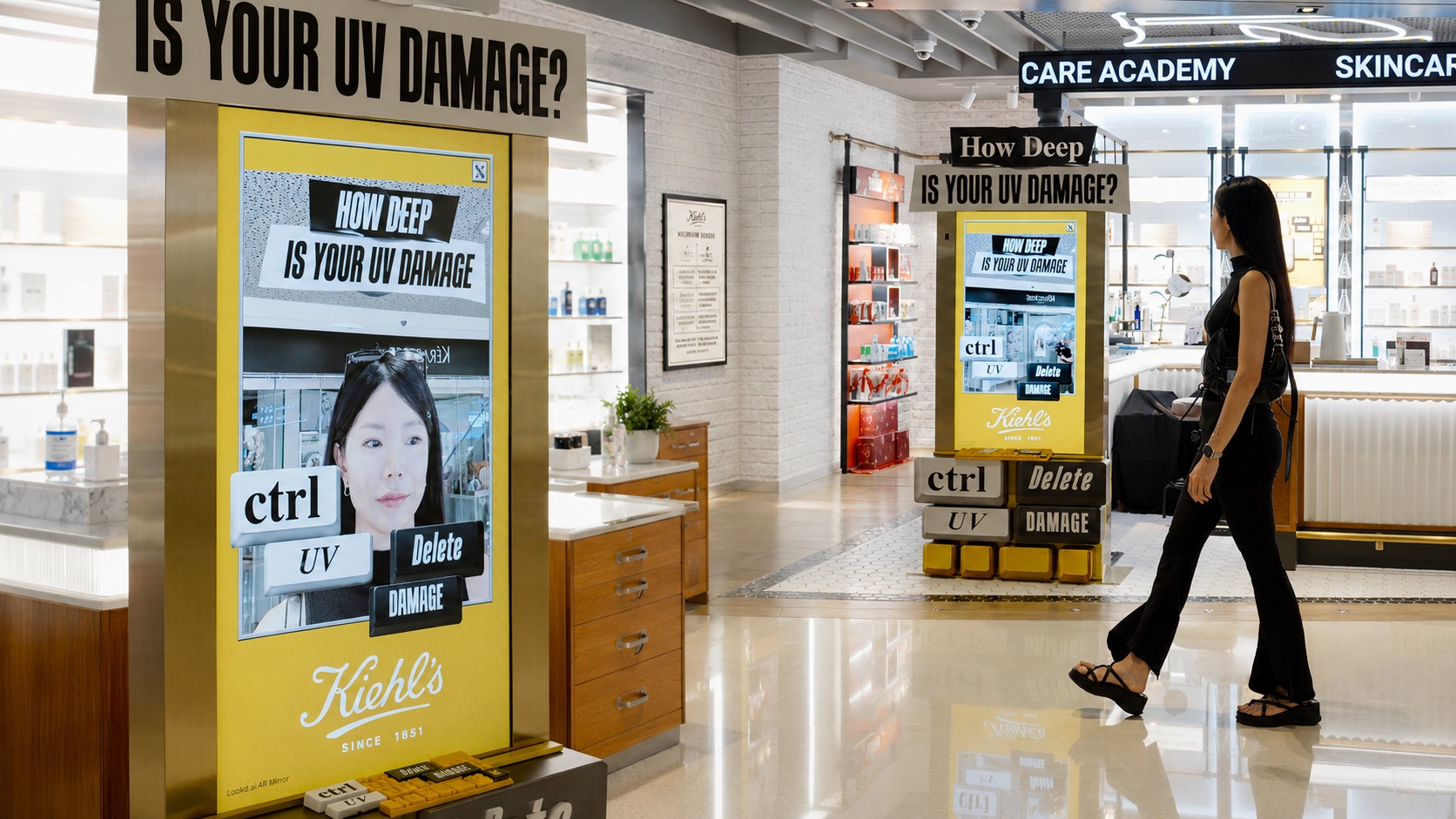
Kiehl's is moving interactive smart mirrors from pilot to permanent fixture, installing them in stores across the UK, UAE, Singapore, Malaysia and China. The rollout follows an augmented reality storefront installation in New York and marks a shift from treating these displays as campaign-driven novelties to treating them as standard store infrastructure.
That distinction matters for anyone managing retail technology budgets. Interactive displays are frequently deployed for a product launch or seasonal push and then removed. Kiehl's is instead committing to permanent installations, with the company indicating further markets are expected over time. That changes the calculus on hardware selection, maintenance planning and content management, since a mirror bolted into a storefront for years needs a different support model than a display rented for a six-week activation.
The mirrors were developed with spatial technology company Loook.AI and use motion sensing to detect approaching shoppers, activating automatically and applying facial recognition-style scanning to personalize what appears on screen. The announcement does not specify what that personalization actually shows shoppers, what data is captured or retained, or how the system handles privacy regulations across five markets with very different rules on biometric scanning, including the UAE and China. Operators considering similar deployments will want those answers before signing off on comparable technology, particularly in jurisdictions with strict biometric data laws.
Kiehl's says the New York installation increased foot traffic by 20%, and that figure is the stated reason for the international expansion. As with any single-market pilot metric, it is worth treating that number as a marketing claim from the companies involved rather than an independently verified result, and the release gives no detail on how foot traffic was measured or over what period.
Engagement claims
Dmytro Kornilov, CEO of Ffface.me, offered a comparison point for why retailers are interested in interactive formats at all. He said A/B testing found shoppers typically watched standard video content on digital signage for about two seconds, compared with seven to ten seconds for interactive mirror experiences. If accurate, that is a meaningful dwell-time gap for anyone trying to justify the added cost and complexity of sensor-driven, camera-enabled hardware over a standard media player and screen. The source material does not detail how that testing was conducted or whether it involved Kiehl's stores specifically.
For CMS and hardware vendors, the Kiehl's program is another data point in the broader move toward sensor-driven, camera-enabled retail displays that go beyond scheduled playlists. It also raises the now-familiar operational questions around permanent smart mirrors: uptime requirements, remote content updates across five regions, and compliance with local rules on cameras and personal data capture in-store.
The announcement in full
Reproduced from invidis for reference. Digital Signage Magazine did not write the text below.
Kiehl's is installing interactive smart mirrors in stores across Europe, the Middle East and Asia as part of a long-term retail technology strategy rather than a temporary marketing campaign.
Kiehl’s is expanding its use of interactive smart mirrors with permanent installations in stores across the UK, UAE, Singapore, Malaysia and China, extending a retail technology program that began with an augmented reality storefront in New York.
Developed with spatial technology company Loook.AI, the mirrors use motion sensing and augmented reality to attract shoppers as they approach. The displays activate automatically and include facial recognition-style scanning to personalize the on-screen experience.
According to the companies, the New York installation increased store foot traffic by 20%, prompting the retailer to expand the concept internationally.
Unlike many interactive retail displays that are used for short-term campaigns, the Kiehl’s installations will remain in stores as permanent fixtures, with additional markets expected over time.
Dmytro Kornilov, CEO of Ffface.me, said interactive displays keep shoppers engaged longer than conventional digital signage.
“Our recent A/B testing found shoppers typically watched standard video content for about two seconds, while interactive mirror experiences averaged between seven and 10 seconds,” he said.
Retailers are moving toward using interactive digital experiences to keep customers engaged inside physical stores, and Smart mirrors have been used for virtual product demonstrations, personalized recommendations, and other in-store experiences as retailers blend digital technology with brick-and-mortar shopping.