INFiLED's TLens LED Package Cuts Power Draw 60% at 10,000 Nits
2026-11-26 · via AV Magazine
INFiLED has launched a new LED package design called TLens that the company says cuts power consumption by 60% while maintaining 10,000 nits of brightness, a figure relevant to anyone operating roadside billboards or other high-brightness outdoor digital signage running long hours.
According to the company, in testing on its MV10.4mk2 display, a screen using TLens reached the 10,000 nit target on 255W/m² of LED power. An identical display built with conventional SMD LEDs needed 650W/m² to hit the same brightness. That is a substantial gap for operators who run large-format DOOH screens continuously and pay the electricity bill for it.
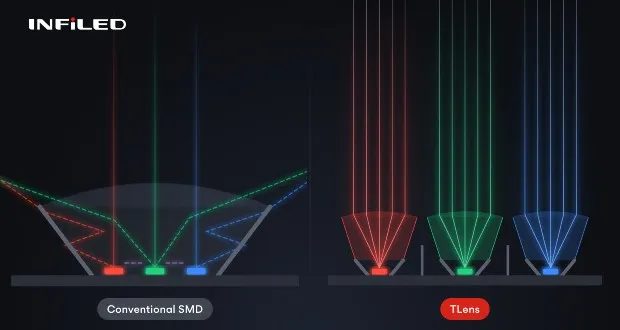
The mechanism, as INFiLED describes it, is a change at the LED package level rather than the panel level. In a standard RGB SMD LED, the red, green and blue chips share a single reflector cavity. Because each colour refracts at a different angle, a shared optical path limits how precisely light can be aimed, and the colours interfere with each other optically. Light also bounces around inside the silicone and package structure, with much of it scattering to the sides instead of heading toward the viewer. To compensate and still hit a brightness target, more electrical power goes in, which also increases heat.
TLens gives each of the three emitters its own reflector cup and micro-lens. INFiLED says this reduces crosstalk between colours and lets each wavelength's optical path be tuned independently. The micro-lenses are designed to capture light from the LED chip's broad natural spread that would otherwise be lost to absorption or wide-angle scatter, and direct more of it toward the main viewing zone using refraction and controlled internal reflection.
What this means for durability and use cases
INFiLED also says the TLens package is physically stronger, withstanding 4.9kg in thrust testing compared with 3.5kg for a conventional SMD LED, which could matter for long-term reliability in outdoor installations exposed to vibration and handling during maintenance.
Because the design concentrates light toward a defined viewing direction, INFiLED positions it as best suited to applications with a clear primary viewing angle, such as roadside billboards and other DOOH screens that run at high brightness for extended hours, rather than displays viewed from a wide range of angles.
TLens is currently available on the MVmk2 Series at 10.4mm pixel pitch. The announcement does not say whether the technology will extend to finer pixel pitches or indoor product lines, nor does it give pricing or a wider availability timeline. It also does not include independent verification of the power and brightness figures beyond INFiLED's own testing, so operators evaluating the claims will likely want to see third-party or field data before factoring the savings into total cost of ownership calculations.
The announcement in full
Reproduced from AV Magazine for reference. Digital Signage Magazine did not write the text below.
By AV Magazine in Digital Signage and DOOH , Displays November 26, 2026 0
The TLens package design for high-brightness DOOH displays gives red, green and blue emitters separate reflector cups and micro-lenses, so that more of the light reaches the audience.
INFiLED has introduced technology that gives the red, green and blue emitters inside each LED their own reflector cup and micro-lens, rather than having them share a single optical cavity.
In testing on INFiLED’s MV10.4mk2, a display using TLens reached a target brightness of 10,000 nits on 255W/m² of LED power, compared with 650W/m² for an identical display built with conventional SMD LEDs.
In a conventional RGB SMD package, the three chips share one reflector cavity. Different wavelengths refract at different angles, so a shared optical path limits how precisely each colour can be directed, and optical crosstalk occurs between them.
Light is also reflected and absorbed repeatedly inside the silicone and the package structure, while broad-angle rays spread off to the sides rather than travelling forward towards the audience.
The screen still has to hit its brightness target, so the shortfall is made up with electrical input, which raises the power demand and thermal load.
TLens addresses that at the package rather than at the panel. Separating the three light paths reduces crosstalk and allows each wavelength to be optimised on its own.
The dedicated micro-lenses collect light from the LED chip’s naturally broad Lambertian emission that would otherwise bounce, be absorbed or disperse at wide angles, and refraction combined with controlled total internal reflection then guides a greater share of it towards the primary viewing direction.
The package is physically stronger as well, withstanding 4.9kg in thrust testing, compared with 3.5kg for a conventional SMD LED.
As the TLens technology concentrates light into the intended viewing zone, it is at its strongest where there is a clearly defined primary viewing direction, such as roadside billboards and DOOH screens running at high brightness for long hours.
TLens is available on the MVmk2 Series at 10.4 mm pixel pitch.