Gila River Casinos Expands DOOH Push With LED, Wallscape and Projection Boards
2026-10-28 · via Digital Signage Today
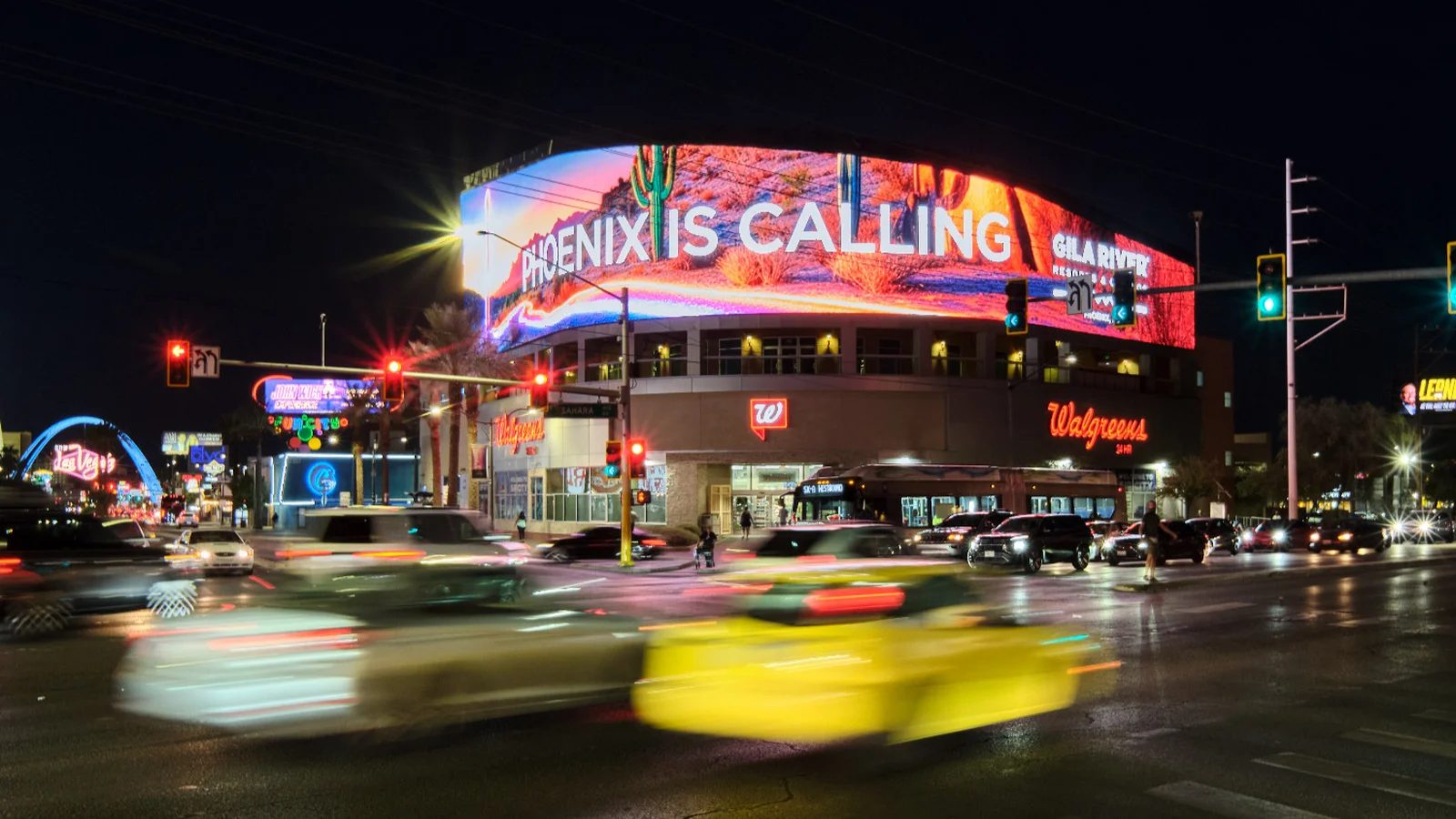
Gila River Resorts & Casinos has rolled out a new out-of-home advertising push spanning Arizona and Las Vegas, combining an LED display in Mesa, a large wallscape in Phoenix, a projection display in Scottsdale and what the company calls a "spectacular" display in Las Vegas. The operator, which runs four casino properties in the Phoenix area, says the wallscape is the largest in Arizona and among the largest in the Southwest.
For digital signage and DOOH operators, the deployment is a useful case study in how a regional brand scales an out-of-home footprint over time rather than in one shot. According to the company, Gila River began investing heavily in OOH in 2017, starting with high-traffic corridors near its own properties in Chandler and Laveen Village before expanding into new markets. Dominic Orozco, the company's president and chief marketing officer, said in an email interview that the brand is now looking to grow market share outside its home turf, including in Las Vegas.
The project was built with longtime partner Harkey Media and ad agency O.H. Harkey Media CEO Scott Harkey called the execution "bold and flawless" in an email interview, pointing to the complexity of coordinating a large-format wallscape alongside LED, projection and spectacular formats across two states.
What operators should take from this
Harkey offered some practical notes that apply broadly to anyone managing large-format or networked OOH campaigns. He said success depends on locking down objectives, whether that is brand awareness, event promotion or driving traffic, before any technology gets deployed. He also warned against the assumption that bigger boards automatically perform better, arguing that location and creative execution often matter more than size.
On the production side, Harkey flagged lead times as a recurring blind spot: permits, production and testing creative under real-world conditions all take longer than clients expect. He also recommended budgeting beyond media space itself to cover production, materials and on-site adjustments during installation, and said internal stakeholder alignment early in the process helps avoid delays.
Orozco framed the broader strategy as a long-term brand play rather than a single campaign. He said OOH remains comparatively unchallenged by the streaming-driven erosion hitting radio and TV, and that billboards function as a kind of marquee that puts the brand in front of commuters repeating the same daily routes.
The announcement does not specify the display technology, resolution or vendor behind the LED board in Mesa, nor does it give a timeline for how long the campaign will run or what it cost. For signage professionals, the piece is less about a product launch and more a reminder of how a mid-size regional brand is using a mix of static, digital and projection formats to build out a multi-market OOH presence incrementally.
The announcement in full
Reproduced from Digital Signage Today for reference. Digital Signage Magazine did not write the text below.
Gila River Resorts & Casinos' latest OOH deployment featured a series of billboards across Arizona and Las Vegas.
October 28, 2026 by Judy Mottl — Editor: RetailCustomerExperience.com & DigitalSignageToday.com, Connect Media
Gila River Resorts & Casinos, which has been operating four resort and casino properties in the Phoenix, Arizona, region for over three decades, is no stranger to digital out-of-home technology and the results that OOH deployments can deliver.
The company began investing heavily in OOH back 2017 and the initial strategy focused on owning the high-traffic corridors in its own backyards to ensure locals were aware of the brand.
Those "backyards" include Wild Horse Pass, Lone Butte and Santan Mountain, located in Chandler, Arizona and Vee Quiva, in Laveen Village. All four properties are owned by the Gila River Indian Community.
"Once we cemented our brand locally, particularly in corridors around our four properties, we began to turn our attention to other places where we wanted to increase market share, reach new audiences, and earn their support," Dominic Orozco, president and chief marking officer of Gila River Resorts & Casinos, said in an email interview.
The company is always looking for the next big opportunity in OOH, Orozco said, whether that's new buildings, new digital formats, different board sizes or extensions.
"We see OOH as a way to stretch our creativity and bring a new perspective to our brand that no one's ever thought of."
Gila River Resorts & Casinos' latest OOH deployment featured a series of billboards across Arizona and Las Vegas. The project included a LED display in Mesa, Arizona; a wallscape in Phoenix, a projection display in Scottsdale and a "spectacular" OOH display in Las Vegas, Nevada.
The company worked with its longtime partner, Harkey Media, and in coordination with advertising agency O.H.
"This was a very complex project, as the wallscape is the largest in Arizona and one of the largest in the Southwest," Harkey Media CEO Scott Harkey said in an email interview.
The execution, said Harkey, was both bold and flawless and he credits Orozco's forward-thinking approach and understanding of the process as keys to success. Orozco consistently pushes for "never been done" activations, said Harkey.
While streaming services have challenged radio and TV, Out-Of-Home is a medium that remains largely unchallenged, according to Orozco, and given that status a billboard series presented an opportunity to expand the company's OOH presence.
The goal of the billboard series is to drive brand awareness and brand impact. The billboard, he said, serves as a company marquee that allows consumers to see the brand in lights — literally.
"The fact of the matter is, just about everyone has a familiar loop they take in their car as part of their daily lives. A billboard acts as a marquee to put our brand's name in lights in highly trafficked areas," said Orozco. "OOH allows us to showcase the size of our brand and make it larger than life in the eyes of consumers. Over time, we build a relationship with them by communicating different messages."
Orozco also pointed out that OOH gives creatives more freedom and an opportunity to take more risks, explore and expand the brand's perspective and drive home key messages.
"The creative team can utilize the landscape with greater creative freedom to effectively convey the message we want to focus on," he said.
"Our OOH footprint is still not complete, nor will it ever be complete, but it's part of our DNA now. We are always looking for the next big opportunity in OOH – whether that's new buildings, new digital formats, different board sizes, or extensions. We see OOH as a way to stretch our creativity and bring a new perspective to our brand that no one's ever thought of."
A big key to OOH deployment success, according to Harkey, is establishing and aligning goals well before technology is deployed.
"Whether the objective is brand awareness, event promotion, or direct traffic, having a defined purpose drives every decision," he said.
One best practice is to develop concise, high-impact creative as billboards only give just a few seconds to capture attention.
"Internally, aligning stakeholders early and understanding approval timelines will prevent delays," he said. It's also important to budget not only for the media space but also for production, materials, and potential adjustments during installation.
A top misconception, when it comes to digital billboards, is that bigger is better. The right location and smart creative work can often outperform size alone, Harkey said.
Another common issue is trying to fit too much information onto a board.
"The most effective messages are bold, simple, and instantly recognizable. We also see clients underestimate lead times, whether it's for permits, production, or testing creative in real-world conditions," said Harkey.
Good planning and an experienced partner can anticipate challenges and solve the challenges before they become hurdles, he added.
Judy Mottl is the editor of RetailCustomerExperience.com and DigitalSignageToday.com at Connect Media. She is an award-winning editor, reporter and blogger who has worked for top media for nearly four decades, including AOL, InformationWeek and Internet News, as well as for leading technology providers including HP. She’s written everything from breaking news to in-depth industry trends and reported on technology long before the internet arrived, including the debut of the first smartphone. When she's not sharing insights on digital signage deployments and trends in retail customer experience she's on the beach or watching the latest live murder trial.
OptiSigns is a cloud-based digital signage software that helps organizations create, manage, and scale engaging screen content across any display. With powerful integrations, flexible scheduling, and easy remote management, OptiSigns makes digital signage simple for teams of any size.
Get the latest news and resources from Digital Signage Today.