Frankfurt Airport Rebuilds Gate A16 Around MicroLED and LiDAR Sensors
2026-10-18 · via invidis
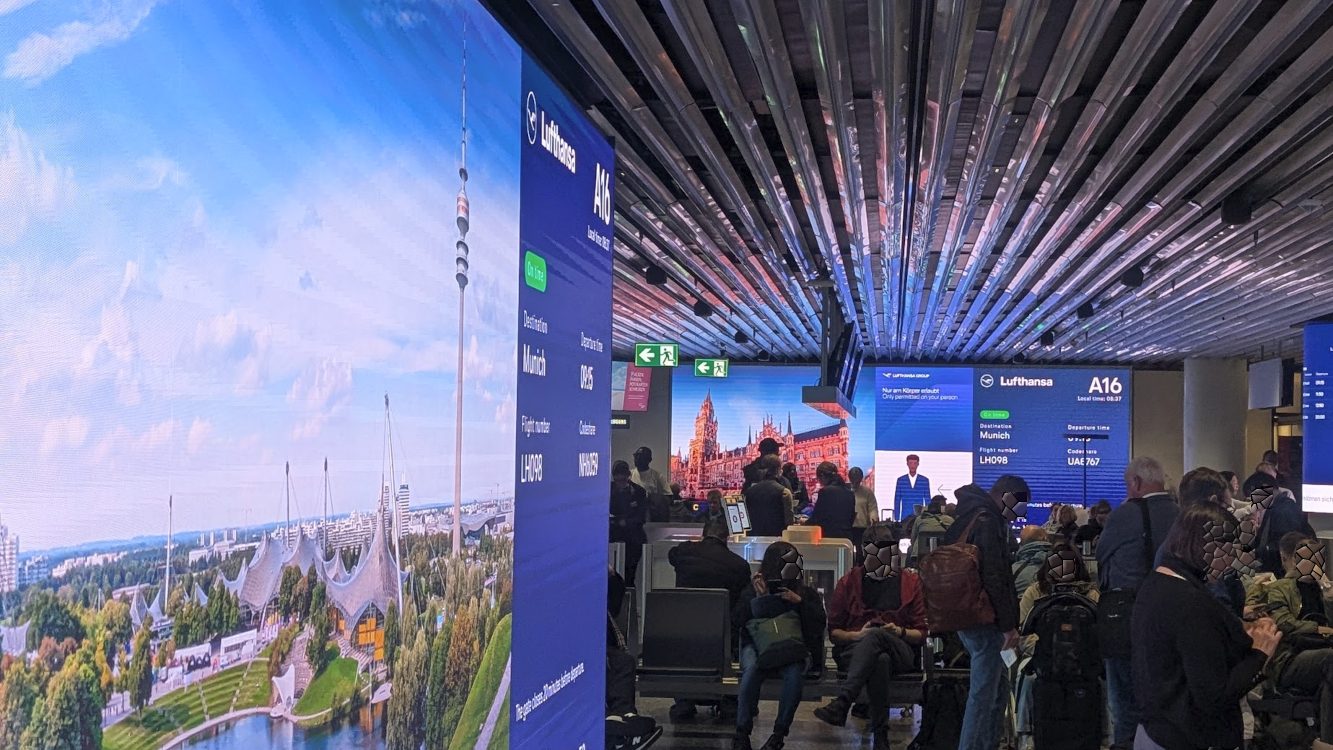
Fraport and Lufthansa have rebuilt Gate A16 at Frankfurt Airport's Terminal 1 around large-format MicroLED displays, LiDAR sensors and digital floor signage, replacing the usual handful of flight information screens with what the companies describe as an integrated information platform covering the whole gate area. For anyone running signage in a transport or large venue environment, it is a useful look at where gate-level digital infrastructure is heading.
According to invidis, the centerpiece is two wall-sized LED surfaces used for both destination imagery and operational messaging, including boarding procedures and passenger guidance, shown simultaneously rather than cycling through separate screens. These are paired with LED-wrapped pillars showing live flight information in the main concourse and waiting areas, built for high contrast and visibility from multiple angles.
Floor signage and mobile staff
One of the more concrete operational changes is Smart Floor Signage, which displays boarding group information directly on the floor instead of relying on barrier tape and small printed signs. Fraport and Lufthansa say this lets passengers self-organize into the correct queue without physical barriers, cutting setup work for gate staff. The gate counter itself has also been shrunk and moved to the side, with agents working from mobile devices around the gate area rather than from a fixed desk, while routine information is delivered on screen in multiple languages.
The gate also uses the extra screen real estate to repeat cabin baggage policy and boarding instructions throughout the wait, which the companies say could reduce the disputes that often happen at the aircraft door over carry-on compliance. The release does not quantify any reduction in delays or complaints, so this remains a stated goal rather than a measured result.
Sensors feeding data, not just displays
LiDAR sensors mounted above the gate collect anonymized data on passenger movement, queue formation, boarding duration and dwell times. Fraport and Lufthansa frame this as a step toward replacing fixed boarding-time assumptions with data drawn from actual passenger behavior on specific routes and times of day, potentially feeding into staffing and gate layout decisions. The announcement describes this as a long-term ambition rather than something already operating in real time at A16.
What the release does not say is as notable as what it does. There is no mention of hardware vendors, display brands, screen sizes, resolution, cost of the installation, or a timeline for rolling the concept beyond this single gate. It is also unclear whether Smart Floor Signage uses projection, embedded LED tile, or another technology, and whether the LiDAR data feeds directly into any existing airport operations system or is being used purely for evaluation at this stage.
For signage operators, the project is a signal that MicroLED and sensor fusion are moving from showcase lobbies into operationally critical, high-traffic environments like boarding gates. Whether Gate A16 becomes a template other airports adopt, or stays a one-off pilot, will depend on data Fraport and Lufthansa have not yet published.
The announcement in full
Reproduced from invidis for reference. Digital Signage Magazine did not write the text below.
Frankfurt | Can digital signage make boarding less stressful and more efficient? Frankfurt Airport's new Gate A16 combines massive MicroLED installations, real-time passenger analytics, and smart wayfinding to redefine one of aviation's most challenging touchpoints.
Few places in the passenger journey combine as many different requirements as an airport boarding gate. Efficiency, transaction processing, waiting time management, wayfinding, information delivery, and passenger comfort all converge in a single space. At the same time, airports serve highly diverse audiences with different cultural backgrounds, languages, travel experience levels, and expectations.
While airport operators, airlines, and handling agents are primarily focused on productivity and operational efficiency, passengers are looking for a smooth, intuitive, and stress-free experience. Bringing these objectives together in a single boarding environment has long been one of aviation’s greatest challenges.
At Frankfurt Airport, one of Europe’s largest and most complex aviation hubs, airport operator Fraport and its largest customer Lufthansa are jointly testing a new approach to reimagining the boarding experience. It is a challenge shared by airports worldwide as passenger volumes increase, operational pressures mount, and traveler expectations continue to evolve.
From Information Point to Information Space
Like many airports, Frankfurt has traditionally relied on a limited number of information displays at the gate: flight information screens, airport TV screens, and static signage positioned at specific touchpoints.
The newly redesigned Gate A16 in Terminal 1 takes a fundamentally different approach.
Instead of treating digital signage as a collection of individual displays, the entire gate environment has been transformed into a digital information platform. MicroLED display play a central role in this new concept, appearing in unprecedented scale, quantity, and positioning throughout the boarding area.
Two massive wall-sized LED surfaces function both as emotional storytelling tools and operational information hubs. Destination imagery, flight-related communication, boarding procedures, and passenger guidance can be presented simultaneously, creating a far more immersive environment than conventional gate setups.
The system is complemented by LED-wrapped pillars that display live flight information visible from the main concourse. Large typography, high contrast, and 360-degree visibility ensure critical information can be accessed from virtually every angle. Even waiting areas are equipped with pillar-wrap LED installations, making flight information omnipresent and accessible throughout the passenger journey.
The result is a boarding environment where information is no longer confined to a handful of small reflective screens but integrated into the architecture itself.
Solving One of Boarding’s Biggest Pain Points
The large-format LED infrastructure does more than improve visibility.
It also creates space to communicate information that frequently causes operational friction. One example is cabin baggage compliance, a recurring challenge for airlines across the industry. Destination-specific content, boarding instructions, and carry-on luggage policies can be communicated more clearly and repeatedly throughout the passenger waiting time, potentially reducing delays and discussions at the aircraft door.
The redesigned gate also reflects a broader trend toward mobile-first passenger handling.
Traditional counter areas have been reduced in size and moved to the side. Rather than remaining behind fixed desks, gate agents can use mobile devices throughout the boarding area, assisting passengers where needed while routine information is delivered digitally in multiple languages.
Smart Floor Signage Replaces Physical Barriers
One of the most innovative aspects of the project addresses a challenge familiar to every frequent flyer: boarding by groups.
At Frankfurt Airport, the boarding process is often complicated by dense passenger flows and infrastructure constraints. Traditional boarding management typically relies on barrier tapes and temporary queue structures that require manual setup by gate staff. Small signs indicating boarding groups are frequently overlooked, creating confusion and reducing passenger satisfaction.
The new concept introduces Smart Floor Signage that visualizes boarding groups directly on the floor. Highly visible digital guidance helps passengers self-organize and move into the correct queue without requiring physical barriers.
This approach not only simplifies passenger navigation but also reduces operational workload for gate agents while making the boarding process more intuitive and less stressful.
LiDAR-Powered Insights into Passenger Behaviour
Behind the scenes, the project goes far beyond visual modernization.
LiDAR sensors installed above the gate area continuously collect anonymous real-time data on passenger movement. The technology enables operators to measure boarding duration, queue formation, passenger flow patterns, and dwell times throughout the process.
These insights provide valuable intelligence for evaluating the floor-signage concept itself, but their potential reaches much further.
For airports and airlines, passenger flow analytics can help identify operational bottlenecks, optimize staffing levels, and improve gate layouts. More importantly, they open the door to data-driven boarding strategies based on actual passenger behaviour rather than generic assumptions.
From Static Processes to Dynamic Boarding
Today, boarding times are largely determined by reference models and standardized planning assumptions.
The long-term ambition of projects like Gate A16 is to replace static models with dynamic operational intelligence. By understanding how passengers behave on specific routes, at certain times of day, or under varying load factors, airports and airlines could eventually adjust boarding processes in real time.
Such data-driven decision making could contribute to shorter turnaround times, more predictable departures, and improved passenger satisfaction.
The transformation of Gate A16 demonstrates how digital signage is evolving from a communication channel into a core operational infrastructure layer.
What is usually a collection of flight information displays has become an integrated ecosystem combining MicroLED visualization, sensor technology, real-time data, mobile agent workflows, and passenger experience management.
For the digital signage industry, Frankfurt’s experiment offers a glimpse into the future of airport operations: a connected, data-driven environment where information, wayfinding, and operational intelligence work together to create a more efficient and more passenger-friendly journey.
As airports worldwide continue to balance efficiency and experience, Gate A16 may serve as an early blueprint for the next generation of boarding gates.