EasySignage Adds AI Assistant Control via Claude, ChatGPT and Gemini
2026-09-29 · via Digital Signage Today
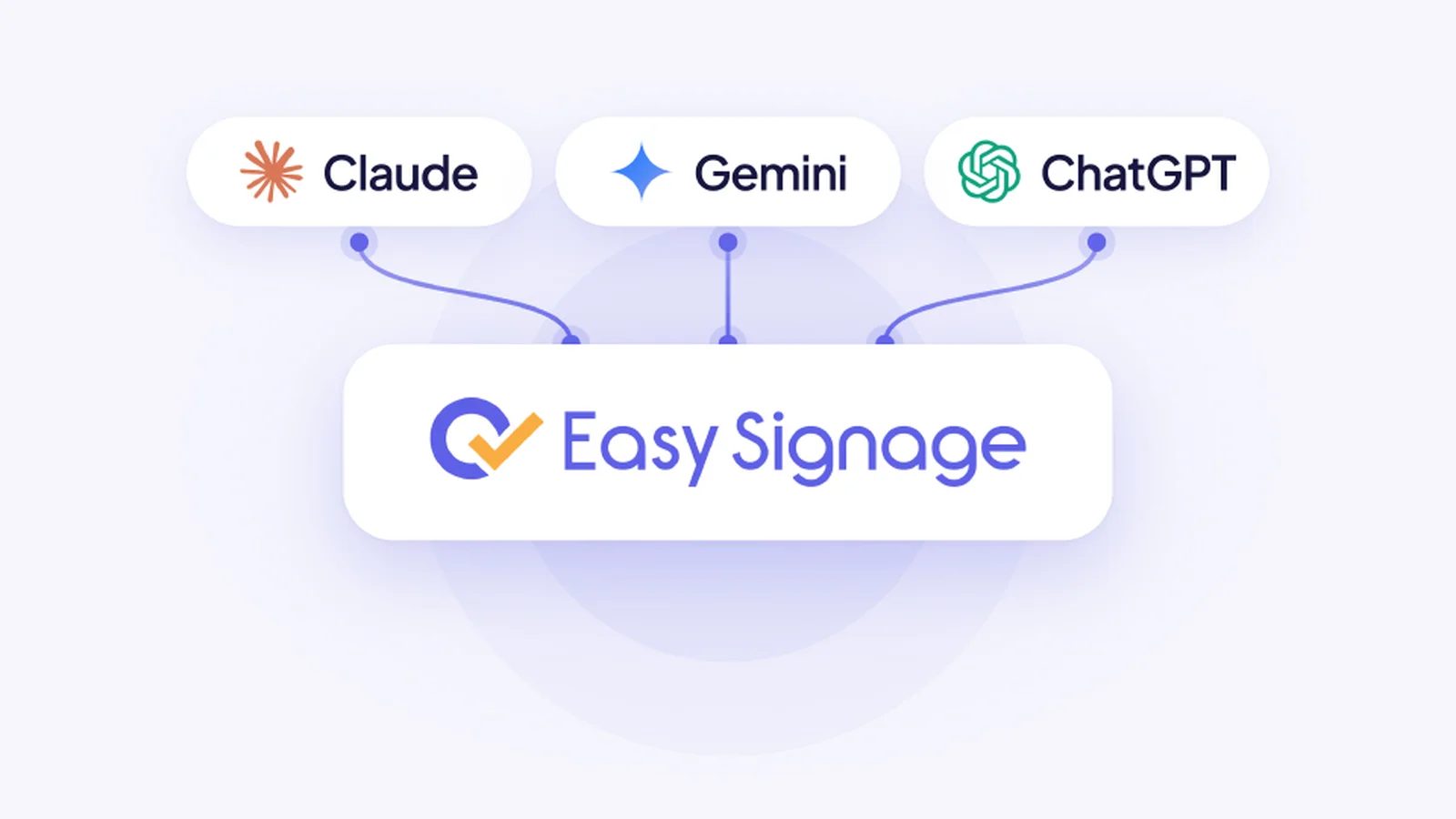
EasySignage has published a white paper describing how its cloud CMS now connects to Claude, ChatGPT, and Gemini through Model Context Protocol (MCP), letting operators check screen status, schedule campaigns, and carry out other account tasks by typing plain-language requests to an AI assistant instead of clicking through a dashboard.
MCP is an open standard that lets AI chatbots call into external software and execute real actions rather than just answering questions. For signage operators, that means the difference between asking an AI "what's the weather forecast" and asking it "push tomorrow's lunch menu to all Texas locations and confirm which screens are offline." According to EasySignage, its implementation supports all three major assistants and breaks access into ten individually controllable permission areas, so an administrator can decide exactly which functions an AI assistant is allowed to touch.
The company also says it has built in a no-delete safeguard, meaning the AI cannot be instructed to remove content or wipe a playlist even if a user's prompt asks for it. That detail matters more than it might first appear. Anyone who has watched a chatbot confidently misread an instruction knows the risk of handing write access to a network of screens over to a language model without guardrails. Permission granularity and a delete lockout are the kind of controls an IT or operations team will ask about before allowing any AI tool near a live signage deployment.
What this means for operators
For teams running networks across many sites, the pitch is speed: fewer clicks, less repetitive dashboard work, and the ability to manage screens through natural language rather than menus. Whether that translates into meaningful time savings depends on how reliably the AI interprets requests across edge cases, something the white paper does not quantify.
The announcement does not say when MCP support became available in EasySignage, whether it is included at all subscription tiers, or how it performs at scale across hundreds of screens. It also does not compare EasySignage's approach to any other CMS vendors that may be experimenting with similar AI integrations, so it is unclear whether this is a first-mover feature or one that will quickly become standard across the category.
EasySignage positions itself as a cloud-based platform supporting Android, Samsung, LG, and Raspberry Pi hardware, with a free tier for a single screen. The MCP integration is presented as an extension of that existing platform rather than a standalone product.
The announcement in full
Reproduced from Digital Signage Today for reference. Digital Signage Magazine did not write the text below.
Managing a digital signage network still means clicking through dashboards, filling in fields, and repeating the same steps for every location. A new category of integration is changing that.
AI assistants like Claude, ChatGPT, and Gemini can now connect directly to signage platforms through MCP (Model Context Protocol) and carry out real account tasks in plain language.
This white paper from EasySignage covers what MCP is, what a connected assistant can do (from checking screen status to scheduling campaigns across multiple sites), why granular permissions and no-delete safeguards matter, and what operators should look for when evaluating MCP in a signage platform. EasySignage's own implementation supports all three major AI assistants with ten individually controllable permission areas and built-in content protection.
Affordable, Powerful Cloud Digital Signage Platform. Manage Any Screen, Anywhere
EasySignage is a cloud-based digital signage software that lets any business design, schedule, and send content to any screen in minutes. With 60+ apps and features along with enterprise-grade security on Google Cloud, it's the smart choice for any industry. Free for 1 screen. Supports Android, Samsung, LG, Raspberry and more.