E Ink Makes First Network Investment, Backs Soofa's 75-inch Color E-Paper Kiosks
2026-11-10 · via invidis
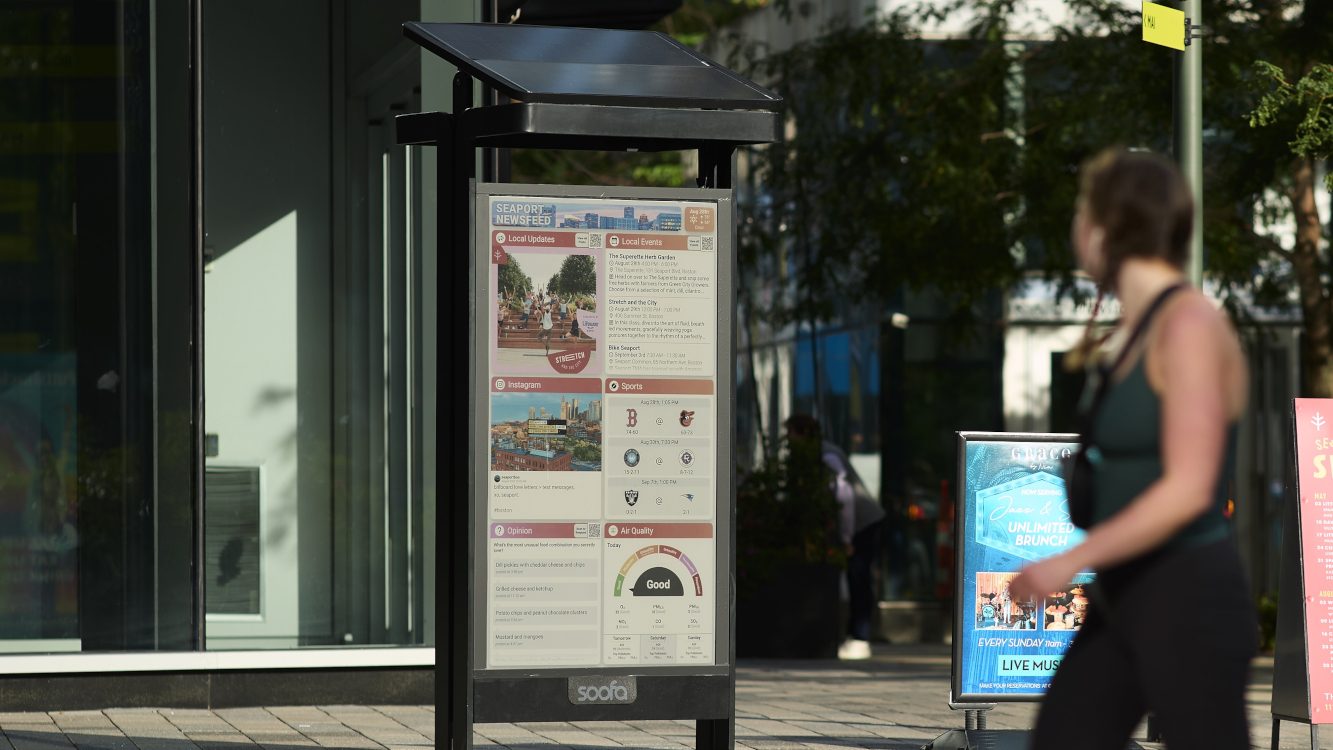
E Ink has taken a strategic stake in Soofa, the Boston-based operator of solar-powered community kiosks, to fund a move from small monochrome screens to 75-inch Kaleido color e-paper displays across US cities. According to the announcement, this is E Ink's first investment in a full network operator rather than a hardware or component partner.
For anyone running outdoor digital signage, the deal matters because it puts a display manufacturer's money directly behind large-format color e-paper at commercial scale, something the industry has talked about for years without many real deployments to point to.
Soofa, founded in 2014, operates kiosks in more than 60 US municipalities including Boston, Atlanta and Los Angeles, delivering local news, weather, transit information and community messages while selling advertising. The company's draw has always been that its kiosks run on integrated solar panels, cutting installation costs compared with wired outdoor LCD units, which can run into five figures before hardware is even factored in, invidis reports. The tradeoff has been limited screen size and monochrome-only content, which has kept Soofa's advertising appeal modest.
Why E Ink is writing the check
E Ink and Soofa both trace their roots to MIT Media Lab and have worked together for more than a decade. E Ink has previously used investment funds to back companies building products around its e-paper technology, aiming to grow the broader ecosystem rather than just sell panels. Upgrading an entire kiosk network to 75-inch color displays is a capital-intensive step that Soofa would likely have struggled to finance on its own, which is presumably why E Ink stepped in directly.
The larger, full-color screens open up advertising and place-based media opportunities that the earlier monochrome kiosks could not support, though the announcement does not give a timeline for rollout, specific city commitments, or financial terms of the investment.
A supplier edging toward the customer's turf
The arrangement puts E Ink in a position similar to Nvidia funding AI infrastructure buildouts: supporting a customer's deployment to accelerate adoption of its own core technology. That also means E Ink is moving closer to the network-operator business itself, which puts it in some tension with display manufacturers such as Dynascan and Samsung, and with out-of-home operators including JC Decaux and Global, who buy or compete with e-paper hardware.
For operators watching the e-paper category, Soofa's network becomes a real-world test of whether large-format color e-paper can justify itself commercially outside premium, power-rich locations, at a time when labor shortages for static poster changes in cities like Tokyo, New York and Munich are adding pressure to find a cheaper digital alternative.
The announcement in full
Reproduced from invidis for reference. Digital Signage Magazine did not write the text below.
E Ink has invested in Soofa, its first stake in a network operator. The solar kiosks are getting 75-inch color displays. The move brings E Ink closer to its own partners.
E Ink is putting money behind its vision for Digital-out-of-Home. The Taiwanese e-paper pioneer has announced a strategic investment in community media network operator Soofa, supporting the deployment of new 75-inch color e-paper displays across major US cities. The move marks E Ink’s first investment in a complete digital signage network operator.
For more than a decade, Soofa has pursued a very different approach to outdoor media. Founded in 2014, the company operates a network of solar-powered community kiosks – better described as digital outdoor totems – that provide residents with local news, weather updates, transit information and neighborhood messaging, while generating revenue through advertising.
The Boston-based company has established partnerships with more than 60 US municipalities, including Boston, Atlanta and Los Angeles. Unlike conventional digital signage deployments, Soofa’s kiosks are designed to operate without a wired power connection, dramatically reducing installation complexity and costs.
From community screens to large-format DooH
The strategic partnership with E Ink will enable Soofa to upgrade its network with 75-inch Kaleido color e-paper displays, moving beyond the small monochrome screens that characterized the company’s earlier generations of kiosks.
The new generation of displays significantly expands the commercial potential of the network. While community messaging remains a core use case, larger full-color screens create new opportunities for digital out-of-home advertising and place-based media.
E Ink has increasingly used dedicated investment funds to support businesses that build products and services around its display technology. By combining capital, product expertise and manufacturing capabilities, E Ink aims to accelerate adoption and expand the overall e-paper ecosystem.
The partnership is rooted in a long-standing relationship. Both E Ink and Soofa trace their origins to the MIT Media Lab, sharing a common background in transforming academic research into commercial applications.
Their collaboration began more than ten years ago and now enters a new phase as both companies seek to demonstrate that e-paper can become a viable platform for outdoor digital communications at scale.
The timing is notable. Following years of development, the digital signage industry increasingly sees large-format color e-paper as a potentially disruptive technology capable of expanding digitization beyond traditional premium locations where power and infrastructure are readily available.
Soofa has yet to achieve a significant breakthrough in the US market with its e-paper-based monochrome community screens. The first generations of its roadside kiosk systems stood out more for their unconventional design than for their digital capabilities. The displays were small, monochrome, and ultimately offered limited appeal for advertisers.
From the beginning, Soofa’s key strength has been its ability to operate independently of the power grid through integrated solar panels. As a result, installation costs are only a fraction of those associated with conventional outdoor digital displays. Installing outdoor LCD screens in transit shelters or as standalone units can easily run into the five-figure range before hardware costs are even considered. Solar-powered e-paper displays, by comparison, offer a substantial cost advantage.
Against this backdrop, E Ink’s investment in Soofa is particularly noteworthy. Upgrading a network to large-format 75-inch e-paper displays would likely have been difficult for Soofa to finance independently. Large-format color e-paper remains one of the industry’s biggest hopes for the future of digital out-of-home, yet there are still very few large-scale success stories.
Now, the display technology supplier itself is investing directly in a network operator. The move is reminiscent of Nvidia’s strategy in the AI sector, where the chip manufacturer supports customers in building AI infrastructure and data centers, helping to accelerate market adoption of its core technology.
The digital signage industry will be watching closely. On one hand, stakeholders welcome the opportunity to see large-format color e-paper displays tested in real-world environments and, ideally, prove their commercial viability. On the other hand, E Ink is moving closer to the end-customer business and, in some respects, into competition with ecosystem partners such as Dynascan, Samsung, and other display manufacturers, as well as major out-of-home operators including JC Decaux, Global, and their peers.
One thing is clear: the direction of travel is set. Achieving full-scale digitization of the Out-of-Home industry will require an affordable large-format display technology that can be deployed economically at scale. Today, staffing shortages are already making it increasingly difficult in cities such as Tokyo, New York, and Munich to find personnel willing to install and replace traditional paper posters. The global out-of-home industry is therefore eagerly awaiting a viable e-paper solution that can finally bridge the gap between static and digital media.