Dynamo LED Displays Builds 360° LED Room Around 86 sq m Display for BAT HQ
2026-11-06 · via AV Magazine
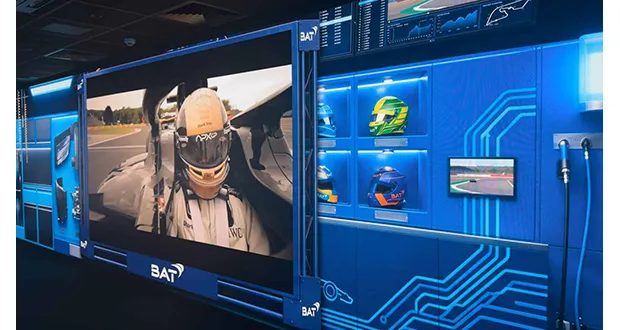
Dynamo LED Displays has installed an 86.1 square metre, seam-free LED wall at British American Tobacco's London headquarters, built as a 360-degree room rather than a screen fitted into an existing space. For operators who spec corporate AV, the project is a case study in what it takes to make hundreds of LED cabinets read as one continuous surface at close viewing distances.
The wall measures 34.72m by 2.48m and wraps the room, made up of 350 of Dynamo's DRE series cabinets arranged 70 cabinets wide by 5 high, at a 1.93mm pixel pitch. According to the company, that works out to roughly 268,000 pixels per square metre and close to 23 million pixels across the whole canvas, driven as a single 17,920 x 1,280 pixel image. BAT uses the space for meetings and presentations as well as sports viewing, with content including a stadium scene for match days, a Formula 1 pit garage, a festive grotto and full-canvas brand takeovers.
Dynamo founder Daniel Reynolds says the brief inverted the usual process: the room was designed around the display rather than the display being sized to fit a finished interior. That meant viewing distances, the structural frame, power and cooling were planned together from the start. The fine pixel pitch was chosen specifically because there is no far wall in a 360-degree room, so viewers sit and stand close to a wraparound surface where a coarser pitch would resolve into visible pixels.
Engineering for seams and power
Holding a 70-cabinet run flat at 1.93mm pitch required side and top locks plus M6 screw fixings between cabinets, rather than relying on lever locks alone, according to Dynamo. Each cabinet carries four modules on magnetic mounts with fine adjustment, letting installers nudge individual modules into alignment without moving the whole cabinet. The company says it calibrated the full array as a single surface for brightness and colour before handover and used NovaStar's seam correction tool to lift brightness slightly at cabinet joins to hide dark lines.
Power draw is rated at a 59.5 kW maximum on 230V, split across 30 circuits so a fault takes out a small section rather than the whole room. Dedicated air conditioning is built around the DRE series' thermal output and is designed to respond to content load, since bright, white-heavy scenes generate more heat than dark ones.
A NovaStar H5 series processor drives the canvas, with two input cards offering HDMI 2.0 and DisplayPort 1.2 inputs, three 20-port sending cards and a preview card. Content came from Apple TV and media players, with Pixel Artworks handling the media player system and content creation, building on prior work with Dynamo at AutoTrader's Manchester office.
The announcement does not give a project cost or installation timeline. Reynolds' advice to others considering a similar room is to start with the space, viewing distances, existing content sources and available power before settling on cabinet count or pixel pitch, and to bring a content partner in from the outset.
The announcement in full
Reproduced from AV Magazine for reference. Digital Signage Magazine did not write the text below.
By Guy Campos in Corporate , Displays , UK&I November 5, 2026 0
Dynamo LED Displays has created an 86.1 sq metre seam-free 1.93mm LED wall for sports viewing and full-canvas brand takeovers at BAT’s headquarters in London.
When a leading multinational company set out to create a 360° LED room for meetings, presentations and sports viewing, it made an unusual decision.
BAT, a FTSE 100 and Fortune Global 500 company known for sports sponsorship, built the room around its 86.1 sq metre display rather than fitting the display to the room.
BAT worked with Dynamo LED Displays on the 34.72m x 2.48m media wall at its London headquarters, with the display company’s partner Pixel Artworks providing media player technology and content.
This content turns the room into a stadium on match day, a pit garage on race day and a full-canvas brand piece in between.
“BAT asked for a room where the display is the architecture, not a screen added to a finished room,” says Daniel Reynolds, founder and managing director of Dynamo LED Displays.
“That reverses the usual order: the room was built for the display, so viewing distances, the structure behind the LED, the power and the heat were designed together instead of being negotiated against an existing interior.”
The LED media wall is made up of 350 of Dynamo LED Displays’ DRE series cabinets in a 70 x 5 array, with a fine pixel pitch of just 1.93mm. Each 496mm cabinet carries 256 x 256 pixels, amounting to around 268,000 pixels per square metre and a little under 23 million across the room, which is driven as a single 17,920 x 1,280 canvas.
Reynolds says the choice of 1.93mm pixel pitch was made because there is no far wall to retreat to in the 360° media room.
“People sit and stand close to a surface that goes all the way round, and a coarser pitch resolves into visible pixels at those distances,” he explains.
Holding a 70-cabinet run flat and seam-free at 1.93mm was also a key installation challenge which depended on the cabinet, the structure behind it, and discipline in setting every cabinet against its neighbours.
“Seventy cabinets in a row means 70 chances for a small error to accumulate. Half a millimetre of misalignment, repeated along the run, leaves the surface visibly stepped by the far end, and at 1.93 mm a gap of a fraction of a millimetre reads as a dark seam,” Reynolds says.
Side and top locks pull neighbouring cabinets together, while direct cabinet-to-cabinet fixings use M6 screws rather than relying on lever locks alone. The cabinets also attach to the supporting frame through M6 and M8 fixing points.
The structure carries about 3.2 tonnes of cabinets, so it had to be true before the first cabinet went on, and every cabinet was then set against its neighbours rather than to a measurement from one end.
Each cabinet carries four 248 x 248 modules and each module sits on magnets with fine adjustment so an individual module can be moved minutely into position against the ones around it without disturbing the cabinet.
“Nobody sees that work when it is right, and it is where a job like this is won or lost,” Reynolds says.
Brightness and colour matter too when making 350 cabinets look like a single surface.
“A cabinet that sits slightly warmer, cooler, brighter or dimmer than its neighbour goes unnoticed on a small screen. On one image sweeping 34.72 m it is the first thing you see, particularly in the full-canvas takeovers,” says Reynolds.
Dynamo LED Displays calibrated the full array as one surface before handover, matching colour and brightness across cabinets. The company also used NovaStar Technologies’ seam correction tool, which lifts brightness by a fraction on either side of every cabinet join, hiding any dark lines at a seam.
In terms of electrical power draw, the media wall is rated at 59.5 kW maximum on 230V, split across 30 circuits from a dedicated distribution box, each on three-core 2.5 sq mm cable.
“That is the design maximum – not what it draws in use,” says Reynolds.
The split puts a little under 2 kW on each circuit on average, keeps every circuit within its limits and means a fault takes out a small section rather than the room.
The heat that comes with a load of this size was another reason to build the room for the display. There is dedicated air conditioning built around the DRE LED series thermal output, designed to react quickly to any rise in temperature caused by the content: a piece with a lot of white in it creates far more heat than a dark one, so the cooling follows the content rather than running at one setting.
A NovaStar H5 series processor manages content across the LED wall’s full 17,920 × 1,280-pixel canvas. The frame in the room carries two input cards, each with two HDMI 2.0 and two DisplayPort 1.2 inputs, three 20-port sending cards giving 60 Ethernet outputs to the wall, and a preview card.
Sources include Apple TV and content media players. Content templates allow a live match to appear in a framed window within an immersive stadium scene, or a brand takeover using every pixel for one piece.
Pixel Artworks installed the media player system and created the content for the BAT 360° media room. This includes a match-day stadium, Formula 1 pit garage, festive grotto and BAT’s own full-canvas takeovers.
“A 17,920 x 1,280 frame is not a format any off-the-shelf footage is made in, and scaling conventional material across it would waste the room,” says Reynolds.
Dynamo LED Displays had worked with Pixel Artworks before, at AutoTrader’s Manchester headquarters and at Pixel Artwork’s own Lighthouse office in Farringdon.
“The split is the same each time: we engineer the display and they make it worth watching, “ says Reynolds.
When BAT uses the 360° LED media room for meetings and presentations, nothing about the hardware changes between uses.
“The same 86 sq metres are a stadium on match day, a pit garage on race day, a grotto in December and a brand environment in between. That is what separates a 360° LED room from a very large television,” Reynolds adds.
If he was advising anyone else who wants a 360° LED meeting and presentation room again, his advice would still be, “Start with the room, not the screen”.
“Give us the room dimensions, where people will view from, the content sources already in the building and the power available; the cabinet count, pitch and canvas size follow from that. Bring the content partner in at the start,” says Reynolds.
“Dynamo has designed, supplied and installed LED for 13 years from London and Dubai, and this is the project I point to when someone asks what a display can be when the room is built for it.”
For more information, see the full case study here: https://dynamo-led-displays.co.uk/bat-london-hq-360-led-room-case-study/