Delhi's Social Tree Landmark Repositions as Premium DOOH Site
2026-08-11 · via invidis
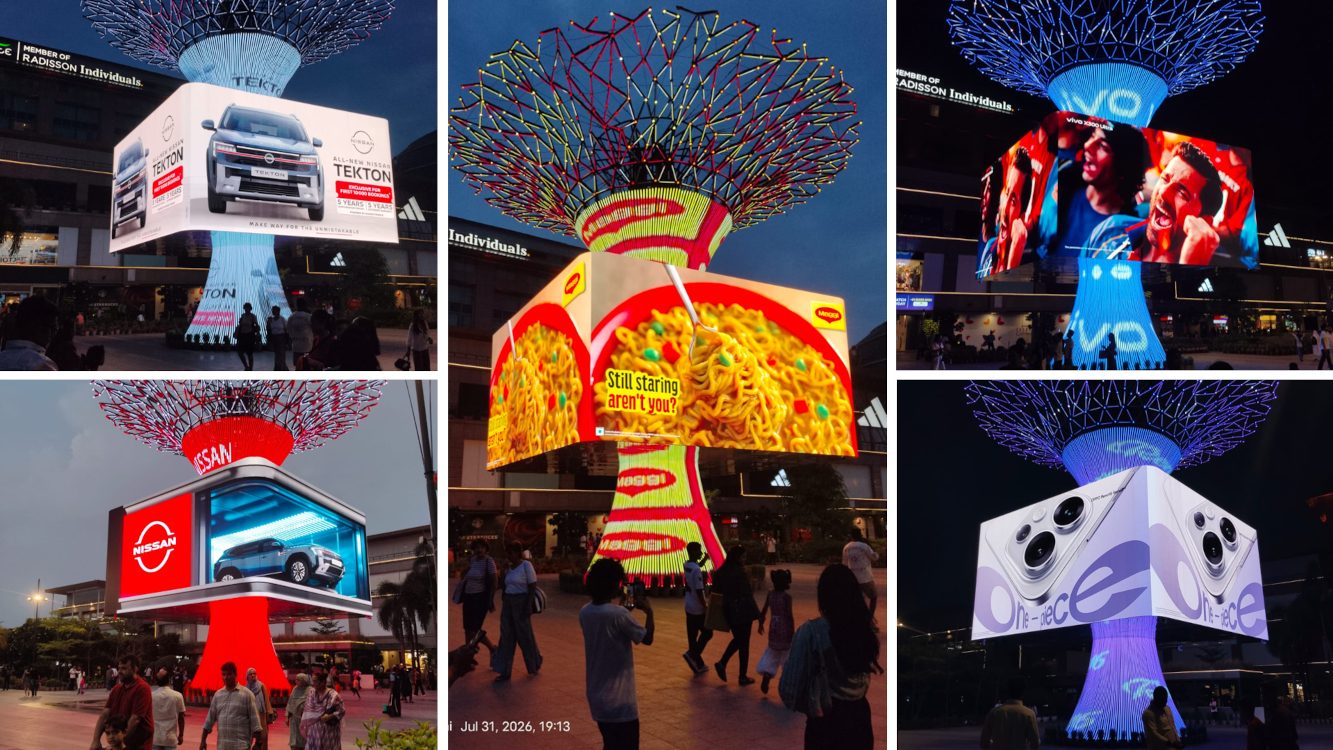
A landmark digital installation in front of a major shopping destination in Delhi is being repositioned as a premium out-of-home advertising site, according to invidis. The Social Tree, a four-sided digital structure originally built as an experiential attraction and social media backdrop, is now attracting national and international brands as a DOOH placement, with Oppo, Maggi, Nissan and Vivo named as recent advertisers.
For operators and media owners, this is a familiar pattern: a piece of urban architecture built for foot traffic and brand experience gets a second life as inventory once it proves it can hold attention. The Social Tree's appeal, per the report, rests on four large-format screens visible from multiple directions in a high-footfall area near the point of sale, plus the ability to run 3D creative and anamorphic effects that make use of the structure's shape rather than treating it as a flat panel.
What the format offers
The pitch to advertisers goes beyond screen space. According to the report, campaigns are extending across the installation's architectural elements, not just the four displays, letting brands build creative around the whole structure rather than a single canvas. That kind of format is harder to sell programmatically and easier to sell as a bespoke, high-visibility buy, which fits the profile of the brands named so far: consumer electronics and packaged goods companies running what look like flagship or launch campaigns rather than routine media buys.
The piece does not disclose pricing, screen resolution, specifications of the individual displays, or who operates or sells the site commercially. It also does not say how audience measurement works for the location, which matters for any advertiser trying to justify the spend against more standard DOOH inventory with established measurement panels. For a market reader, that is the obvious gap: novelty and visibility are one thing, but agencies buying premium landmark DOOH increasingly expect audience data to back it up, and none is mentioned here.
What the report does make clear is the direction of travel. A structure built primarily to be photographed is being reframed as media infrastructure, with the experiential function now treated as a value-add for brands rather than the primary purpose. That mirrors a broader trend across large urban markets, where landmark screens and installations originally funded as placemaking or civic projects get commercialised once footfall and dwell time prove reliable.
For operators watching the Indian DOOH market, the Social Tree's trajectory is worth tracking as a signal of how landmark digital structures in other Indian cities might be positioned and sold going forward, though the source gives no indication of expansion plans or comparable projects elsewhere.
The announcement in full
Reproduced from invidis for reference. Digital Signage Magazine did not write the text below.
Delhi's Social Tree is evolving from an iconic experiential installation into one of India's most sought-after DooH destinations. With four-sided screens, 3D creative capabilities and campaigns that extend beyond the display itself, the landmark is attracting a growing roster of major brands.
When the Social Tree was unveiled in front of one of the Indian capital’s most prominent shopping destinations, the focus was firmly on experience. The striking four-sided structure quickly became a popular meeting point, social media backdrop and architectural landmark. Today, however, its role is evolving.
The latest activation at the Social Tree show how the installation is increasingly positioning itself as one of the country’s most recognisable Digital Out-of-Home assets.
While the experience factor remains central to its appeal, brands and agencies are beginning to view the Social Tree as much more than an Instagram-worthy attraction. The structure is emerging as a premium DooH platform that offers advertisers a combination of scale, visibility and creative flexibility rarely found in traditional outdoor media.
At the heart of the concept are four large-format digital displays that deliver visibility from multiple directions within a high-footfall urban environment steps away from the point of sale. The format enables advertisers to create campaigns that engage audiences from every angle, turning the structure itself into a media destination.
The opportunity extends beyond standard digital advertising. Brands are increasingly experimenting with 3D creatives and anamorphic effects, while others are incorporating the surrounding architectural elements into their storytelling. Campaigns are extending beyond the screens across the entire installation.
The market response suggests that advertisers are paying attention. Over recent weeks, a growing number of leading brands have appeared on the Social Tree, including Oppo, Maggi, Nissan and Vivo.
More Than a Landmark : Social Tree Wins Over Advertisers
LED : Brompton Technology Helps Power Virtual Production for ITV Drama Believe Me
OoH : AI Boom Sends San Francisco Billboard Prices Soaring
Business : Outfront Names New Executives
Metro : Premium DooH for India’s Financial Capital