Daktronics Installs 360-Degree LED Centerhung at Alabama's Coleman Coliseum
2026-11-16 · via invidis
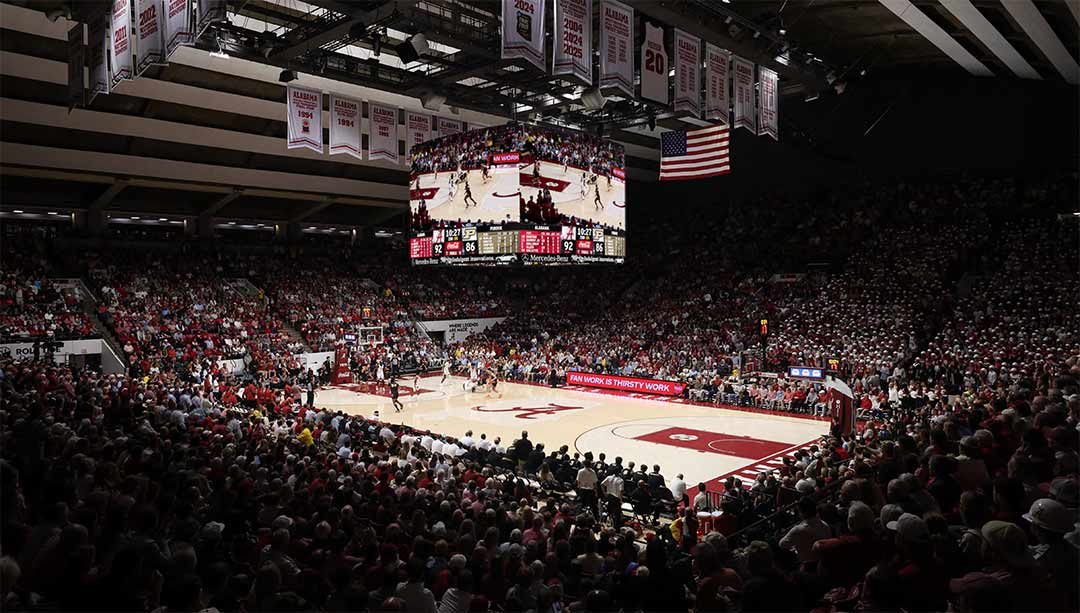
Daktronics has replaced the 2009-era centerhung display at the University of Alabama's Coleman Coliseum with a new 360-degree LED system, part of a broader arena upgrade that adds six more displays. For venue operators weighing LED refresh cycles, the jump illustrates how far pixel density has moved in roughly 15 years and what that means for content flexibility.
The new centerhung measures about 20 feet high and 102 feet in circumference, built from more than 13.4 million LEDs at 3.7mm pixel spacing. Daktronics says that works out to 30 times the pixels of the previous main screens, which ran at 10mm spacing. The old system was also four separate screens; the new one is a continuous wraparound surface, meaning content can move around the structure rather than being cut into quadrants.
Four additional displays sit beneath the centerhung structure to serve spectators seated closer to the court, each about 2 meters high by 6 meters wide at 3.7mm pixel spacing. Two end-wall displays, each roughly 34 meters by 43 meters according to the release, use 3.9mm spacing and extend coverage to the rest of the arena. Those end-wall dimensions as stated would make them larger than the arena itself, so the figures likely refer to a different unit than meters; the announcement does not clarify.
Aaron Hepp, assistant athletic director at Alabama, said the installation gives the athletics department more flexibility in building and running game-day content, according to Daktronics. The company has worked with Alabama Athletics for more than 30 years and supplied the 2009 system this one replaces.
What it signals for venue operators
The project is another data point in a trend that has been running through collegiate and pro sports venues for several years: operators are moving away from segmented centerhung boards toward continuous, high-density LED wraps that behave more like a single canvas than four screens bolted together. That shift matters for production teams because it removes the seams that used to constrain replay graphics, sponsor reads and in-game statistics layouts.
The announcement does not give a project cost, installation timeline, or contract value, and it does not name the content management or production system driving the new displays. It also does not say whether the arena's older peripheral signage, scoreboards or ribbon boards were touched as part of this upgrade. For an industry still debating replacement cycles on large-format sports LED, a 15-year lifespan before a full centerhung swap is a useful benchmark, though actual replacement timing depends heavily on budget cycles and conference broadcast requirements that the release does not address.
The announcement in full
Reproduced from invidis for reference. Digital Signage Magazine did not write the text below.
A new centerhung display at Coleman Coliseum delivers 30 times the pixels of its predecessor, supported by six additional screens throughout the venue.
Daktronics has installed a new LED display system at the University of Alabama’s Coleman Coliseum in Tuscaloosa, replacing a centerhung installation dating back to 2009.
The centerpiece for the perrenial college sports powerhouse is a 360-degree LED display measuring approximately 20 feet high and 102 feet in circumference. Featuring more than 13.4 million LEDs, the display provides 30 times the pixels of the previous main screens, delivering higher-resolution video, graphics, statistics and replays during Crimson Tide basketball games and other events.
The centerhung system uses 3.7-millimeter pixel spacing, a significant improvement over the previous installation’s 10-millimeter spacing. The continuous display surface also allows content to wrap around the structure instead of limiting it to four separate screens.
Four additional displays are mounted beneath the centerhung structure to improve visibility for spectators seated closer to the court. Each measures approximately 2 meter (6.6 feet) high by 6 meter (20 feet) wide and uses 3.7-millimeter pixel spacing.
Two end-wall displays, each measuring approximately about 34 meter (11.2 feet) high by about 43 meter (14.1 feet) wide, provide further coverage throughout the arena. These feature 3.9-millimeter pixel spacing.
Aaron Hepp, assistant athletic director at the University of Alabama, said the new installation gives the athletics department greater flexibility to develop and present game-day content.
The project continues a relationship between Daktronics and Alabama Athletics spanning more than 30 years. Daktronics also supplied the previous centerhung system, installed in 2009, which consisted of four displays.
The upgrade is another example showing the growing emphasis on high-resolution LED technology in collegiate sports venues, where large-format displays are increasingly central to live production, audience engagement and the overall game-day experience.