Color E-Paper Signage Improves, But Cost Gap With LCD Persists
2026-11-19 · via invidis
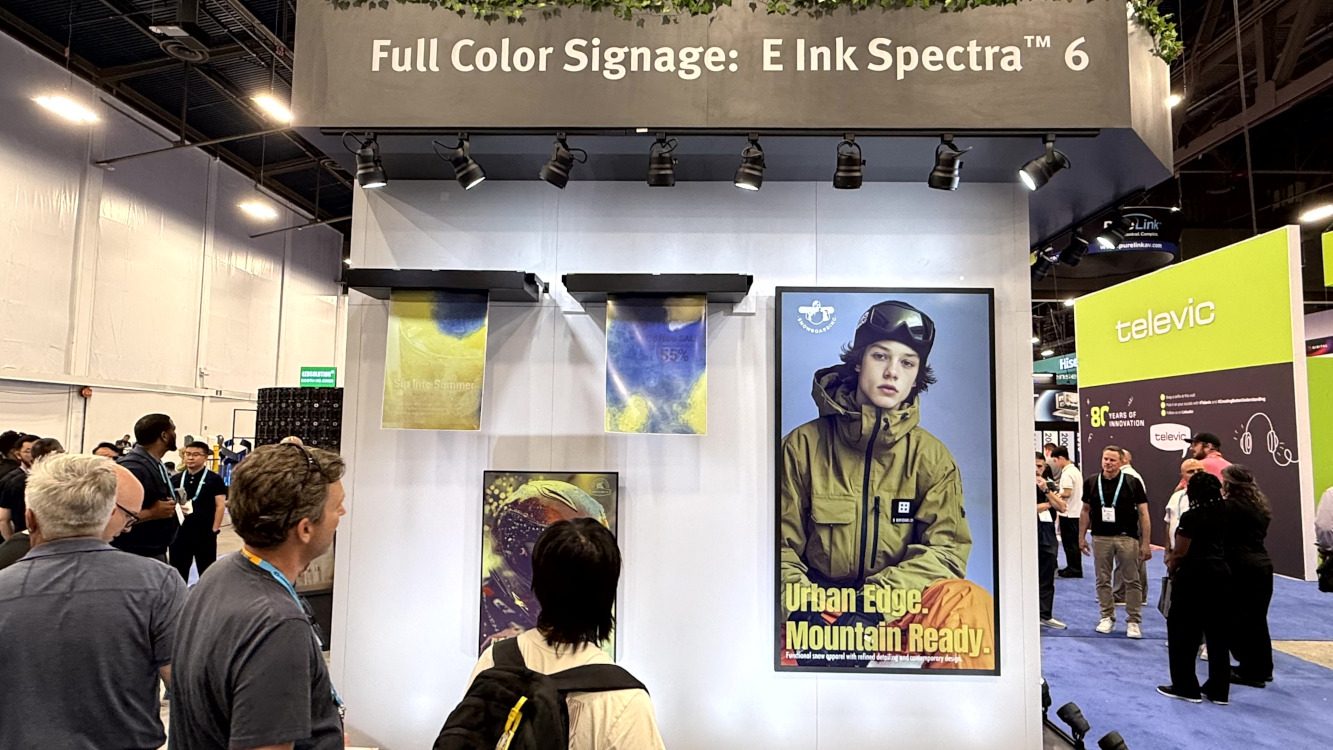
Industry analyst Dave Haynes, writing in his Haynes Column for invidis, argues that color e-paper displays have matured enough to be a credible alternative to LCD for some signage applications, but that price remains the barrier stopping wider adoption.
Haynes traces the technology back roughly 25 years to E Ink's spinout from MIT's Media Lab, noting that nearly every e-paper display sold by major manufacturers, whether branded Sharp, Samsung or otherwise, runs on E Ink's underlying electrophoretic panels. He says E Ink holds thousands of patents it enforces, meaning most of the industry's "innovation" at trade shows is really E Ink's technology with a manufacturer's own housing and software layered on top.
The column looks at two recent E Ink announcements. Spectra 6 9-Color adds orange, cyan and light green to the existing six-color Spectra 6 palette, which Haynes says produces more natural skin tones and less visible pixelation. He notes the catch: the only version currently available is a 10-inch panel, too small for most commercial signage uses.
The second announcement, Kaleido 4, doubles the color gamut to over 40,000 colors and pushes resolution to 300 pixels per inch, according to E Ink. It also adds support for video playback at up to 18 frames per second. Haynes calls this both interesting and strange, since video support undercuts e-paper's core selling point: the ability to run for months on batteries or solar power because the display only draws power when content changes. He writes that supporting video likely makes a conventional LCD the more sensible choice in most deployments anyway. He also says he saw a Kaleido display running video at ISE 2026 that looked grainy, though he thinks the full 18 fps capability would look better.
The cost problem
Haynes's central point is capital cost. He says a 32-inch color e-paper display still runs several multiples of the price of an equivalent LCD, though the gap may have narrowed slightly since he last checked. He cites a discounted 32-inch Samsung Spectra 6 unit at $650 (marked down from a $1,500 list price) and a similarly sized Philips Tableaux display listed above $1,700, and speculates the Samsung markdown could signal the company pulling back from a product that has not hit sales targets.
He points to smaller, more focused e-paper specialists like Slovenia's Visionect and Taiwan's Agile Display Solutions as better indicators of where the technology is genuinely heading, compared to larger manufacturers he describes as following a "me too" pattern.
Haynes closes by arguing that e-paper's biggest realistic market is replacing printed posters and signage, given the scale of the printing industry, rather than displacing LCD-based digital signage outright, and that it should still be considered digital signage technology.
The announcement in full
Reproduced from invidis for reference. Digital Signage Magazine did not write the text below.
Refresh rates, color quality, and cost, cost, cost. Dave Haynes takes a hard look at how far e-paper displays have come, what's still holding it back, and whether the industry is solving the right problems.
Back some 25 years, having found myself made collateral damage in a merger, I started poking around online to try sorting out what was next for me and for the technology industry I’d found my way into a couple of years earlier. And one of the things that was JUST starting to emerge was e-paper.
E Ink had been spun out of MIT’s renowned Media Lab and was starting to develop the first consumer/commercial applications of electronic paper. It struck me that at some point, as development continued and the tech matured, this stuff had possibilities for digital signage.
A quarter-century on, those possibilities are real, and there are now e-paper displays that can credibly be considered as an alternative to much more established technologies like LCD displays. But one big problem remains, and I’m not sure it will get resolved. More on that point in a bit.
First, let’s look at where we are 10 weeks or so out from Integrated Systems Europe, the largest trade show addressing the pro display sector globally (though there are some monster domestic-focused shows in China and Japan).
The show in Barcelona will undoubtedly, again, have numerous mainstream and specialty manufacturers showing their twist on color e-paper displays at stands. In a lot of cases, they’ll be presented as the company’s own product innovation, but they’re all (or almost all) displays that use E Ink’s electrophoretic display technology.
So a Sharp e-paper display, or a Samsung, or pretty much anyone else’s, is E Ink paper with some added tech or window dressing from the manufacturing partner. I have come across a few Chinese companies that have their own takes on e-paper, but E Ink Holdings has 1,000s of patents the company asserts when necessary.
E Ink got traction and grew into a substantial company in the US and more so in Hsinchu, Taiwan on the back of monochromatic “paper” used for e-readers and electronic shelf labels. Black and white microcapsules respond to electrical charges to appear or disappear to create legible text or basic images.
The company has been working on color through the years and by 2010 had something called Triton, that could produce 16 shades of grey and 4,096 colors. I was at Computex in Taiwan in, I think, 2014 and saw an early demo of E Ink color e-paper, which used a color filter overlay to realize color. It looked kinda terrible.
By 2016, at the SID display nerd conference in California, E Ink was showing what it labeled as Advanced Color ePaper. That removed the need for the color filter and meant viewers were looking at color micro-capsules.
That was the point when E Ink started showing real possibilities for digital signage and digital out of home applications – that weren’t based around video, and had primary demands or restrictions on energy consumption. The main value proposition of e-paper, if the tech remains somewhat unfamiliar, is that natural and ambient light illuminates the reflective surface of these displays (instead of powered backlights), and they only need electricity when what’s on the display is changed.
The visual quality of these color products has seen steady improvement in the past decade, and what’s on show now generally looks really good – visually acceptable for most use-cases.
Which brings us to the present. E Ink has in recent weeks announced a couple of major updates:
Spectra 6 is the company’s primo, rich color product – and a new version called “ Spectra 6 9-Color ” adds orange, cyan, and light green to the black, white, red, yellow, blue, and green that Spectra 6 already supported. The differences are subtle – notably more natural skin tones and less visible pixelation. The big limiter is that, at least for now, the only version is a 10-inch unit, which is going to be too small for many to most commercial display applications.
Last month, E Ink announced Kaleido 4 – the newest generation of its more mainstreamed, more affordable color product. Kaleido 4 doubled the color gamut to over 40,000 colors and the color resolution to 300 pixels per inch. The backplane was upgraded and software tweaked to also support video playback of up to 18 frames per second.
The video support aspect is both interesting and weird. The commercial applications for color e-paper have always been constrained by demands for motion graphics on many to most deployments, and while 18 frames is not the industry standard of 30, it’s pretty good.
This video shows different frame rates , including 20 FPS, which is pretty close.
You are currently viewing a placeholder content from YouTube . To access the actual content, click the button below. Please note that doing so will share data with third-party providers.
I saw a Kaleido display with embedded video at ISE 2026, and it was grainy and terrible. But at 18 FPS the “4” can do, it probably would have been visually acceptable.
You can see some color e-paper with video about halfway through the show roundup video I did from ISE 2026 :
You are currently viewing a placeholder content from YouTube . To access the actual content, click the button below. Please note that doing so will share data with third-party providers.
The problem, though, is that supporting video largely neuters the primary value proposition of e-paper – that it can run on batteries and use attached solar collectors to run off the grid for months. Maybe there are exceptions, but in most cases using a conventional LCD is going to make more sense for a bunch of reasons.
Which gets me to the big point – capital costs. Color e-paper displays are still many multiples of the cost for a same-sized LCD display. The last time I ran a check, a 32-inch color e-paper display cost about 8-10X more. I just ran another check and that has maybe come down a bit, but they’re still far more costly, and the ROI thing about reduced energy usage with e-paper would not work in many spreadsheet exercises.
I DID find a 32-inch Samsung based on Spectra 6 that had what amounts to Black Friday pricing (US$650, marked down from $1,500 MSRP). But that just makes me wonder if Samsung is once again backing out of a product that doesn’t deliver the sales volumes it needs.
Meanwhile, a Philips Tableaux 32-incher – roughly the same thing as the Samsung – is listed at north of US$1,700.
I met with E Ink in Taiwan a couple of years back, and then had a good demo at Infocomm back in June. The floppy, laminated paper-thin versions of Spectra 6 were super interesting. Every time I have spoken with company people, they’ve confirmed unit cost is an issue and that it will come down with time.
When I wander into the Fira Gran Via in Barcelona in a few weeks for ISE 2027, I expect to still see a bunch of manufacturers doing some kind of showcasing around color e-paper. But it’s no longer a shiny new object for most of them, or for the throngs of integrators and solutions providers who attend ISE. So the profile, will, in many cases, likely be lowered.
What I tend to do, when I am looking for e-paper advances and applications, is look for the usually much smaller companies focused on the tech – like Slovenia’s Visionect (which makes black and white look beautiful) and Taiwan’s Agile Display Solutions.
There is a “me too” thing going on with many or most of the big display guys, so the little guys heavily focused on the tech often tend to better reflect what the market is asking for and what’s possible.
I really like the tech, particularly the Spectra 6 that really does now rival good quality color prints off presses. I don’t get the drive to support color, as it dilutes the energy savings argument. But I suppose if video support doesn’t technically compromise something else, and add cost, why not?
I heard a manufacturer’s rep at the Digital Signage Summit in Munich suggest in a panel that E Ink spend more of its time fully stabilizing the product before it farted around with video. That was intriguing.
We may still be years away from a time when capital and operating cost exercises reveal color e-paper makes more sense than LCD for a deployment. But there are millions and millions of printed posters out there – and more than 21,000 printing companies just in the US. That’s very likely the addressable market for color e-paper, though again – cost.
Final point or question: Is it digital signage technology?
It’s been argued that e-paper is a paper replacement, not something that supplants pro displays. I’d argue it is digital, and its highest potential is supplanting printed signs, so Yeah, it’s digital signage.