Brompton Tessera Processing Drives LED Art Installation at Art Basel Hong Kong
2026-08-25 · via invidis
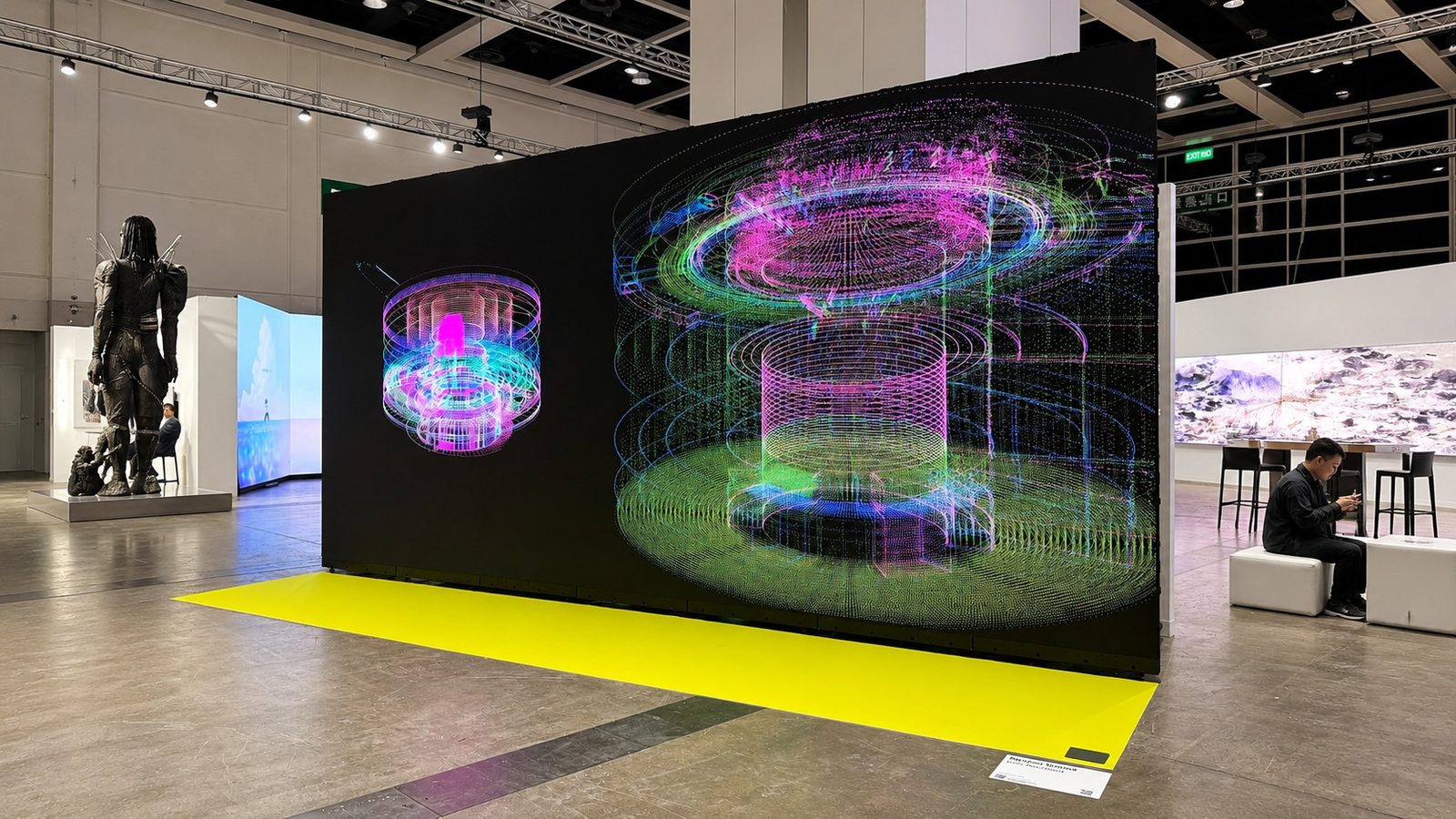
Brompton Technology's Tessera processing line was used to drive a large-scale LED art installation by German digital artist Kim Asendorf at Art Basel Hong Kong, according to the company. The project is a reminder that the same processing gear sold for retail, corporate and events signage is also finding work in gallery and fine-art contexts, a market that cares as much about color accuracy and black-level performance as any premium retail install.
The piece, called Pxl Duo Pod, ran on two side-by-side ROE Visual Topaz LED screens with a 2.6mm pixel pitch. Brompton's Tessera SX40 4K processors and Tessera XD 10G data distribution units handled the signal chain. The installation showed two evolving digital forms whose colors, movement and pixel density interact with each other, and visitors could use a control pad to rotate the forms, zoom in and change camera angle.
According to Brompton, the setup was chosen to reproduce individual points of light, precise color work and deep blacks while keeping visible separation between pixels, all details that matter to an artist working at the pixel level rather than with broadcast or video content. Asendorf is quoted saying he now considers Brompton controllers his default choice, calling the visual result on LED walls "almost surreal."
The installation was presented by the Nguyen Wahed gallery as part of Zero 10, Art Basel's digital-art program. The announcement notes that Asendorf previously used Brompton processing for a different work, Raster und Spektrum, at Art Basel Miami Beach, but that piece was displayed on Absen panels rather than ROE Visual screens.
Why the LED brand didn't matter
The detail worth flagging for integrators and rental/staging operators is the cross-brand consistency angle: Brompton is positioning Tessera as a common processing layer that produces comparable results across different LED panel manufacturers. For an artist or producer who needs a work to look the same regardless of which screens a venue has installed, that portability is the selling point, not any single hardware spec.
The release does not say what content source or media server fed the processors, how the interactive control pad communicated with the display system, or what the installation cost to mount. It also does not specify brightness, refresh rate or HDR handling on the Topaz panels beyond pixel pitch. For readers running commercial signage networks, the piece is less about a new product launch and more a case study in how existing Brompton processing hardware performs under demanding color and black-level requirements outside its usual retail and corporate installs.
The announcement in full
Reproduced from invidis for reference. Digital Signage Magazine did not write the text below.
Kim Asendorf’s interactive Pxl Duo Pod was presented on adjoining Roe Visual LED screens, using Tessera processing to reproduce its evolving colors, individual pixels and deep black backgrounds.
Brompton Technology’s Tessera LED processing powered a large-scale interactive installation by German digital artist Kim Asendorf at Art Basel Hong Kong.
Pxl Duo Pod was presented on two side-by-side ROE Visual Topaz LED screens with a 2.6 mm pixel pitch. Brompton Tessera SX40 4K processors and Tessera XD 10G data distribution units drove the displays.
The work places two evolving digital forms side by side, allowing their colors, movement, and pixel density to interact. Visitors could use a control pad to rotate the forms, zoom in and change the camera angle.
The LED setup reproduced the work’s individual points of light, carefully developed colors and deep black backgrounds while preserving the separation between pixels.
Presented by the Nguyen Wahed gallery, Pxl Duo Pod was part of Zero 10, Art Basel’s digital-art program.
“I care deeply about display quality, but what Brompton controllers bring to LED walls is almost surreal,” Asendorf said. “Now I have a first-choice setup.”
Brompton processing was also used for Asendorf’s Raster und Spektrum installation at Art Basel Miami Beach, where the artwork appeared on Absen LED panels.
Although different LED brands were used in each location, Brompton provided a common platform for maintaining the details central to Asendorf’s work.