AUO Display Plus Pushes Open Software Layer for E-Paper Signage
2026-09-20 · via invidis
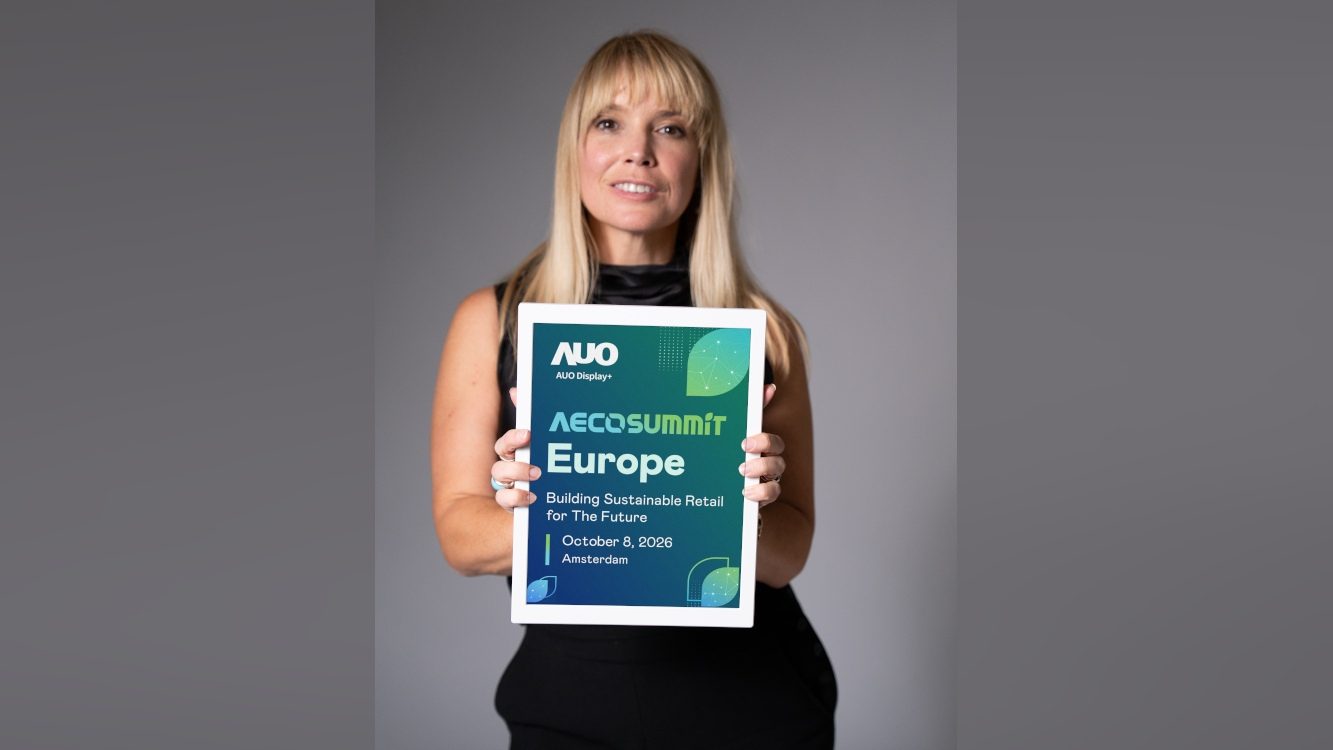
AUO Display Plus (ADP) is positioning software, not the display itself, as the main obstacle holding back large-format e-paper signage from wider adoption. The company laid out its case ahead of AecoSummit Europe 2026, which it will host on 8 October in Amsterdam, in an interview with Sian Rees, its Business Development and Ecosystem Strategy lead, published by invidis.
The argument matters to anyone evaluating e-paper for retail, transport or public-sector deployments. E-paper's pitch has always been about replacing paper, not backlit screens: shelf-edge tickets, timetables and posters, run on batteries with minimal power draw. But according to Rees, integrators have been slowed down by proprietary CMS integrations and fragmented ecosystems rather than by the panels themselves.
ADP's answer is AecoSign, a lightweight platform built on a microservices architecture that provides an API layer for connecting different content management systems to e-paper hardware, rather than requiring each CMS vendor to build its own hardware-specific integration. The company says the architecture is meant to extend across its wider display portfolio over time, not stay limited to e-paper.
A notable design choice is that the microservice can run inside a software partner's own infrastructure rather than through a third-party cloud middleware layer. ADP points to this as a sovereignty and accountability play: partners can commit to their own uptime service levels instead of depending on someone else's cloud, and organizations retain control of data within infrastructure they already manage, which the company says matters for European customers facing GDPR and procurement requirements. Navori is cited as an early example, moving from a proof of concept shown at ISE 2026 toward a supported integration.
This positioning is worth noting given ADP's own conflicts of interest: the group owns ComQi and Rise Vision in North America and Space4M in Asia. Rees frames the open API approach as a deliberate choice not to force ADP's own CMS on customers, though the announcement does not detail how AecoSign's terms or costs compare across competing software partners.
The release also flags color performance as an emerging differentiator, since Rees says customers judge e-paper against printed materials rather than LCD benchmarks, and the industry still lacks common standards for describing color on electronic paper. ADP's manufacturing position stems from its 2025 joint venture with E Ink, in which ADP holds 51 percent, covering large-format e-paper module production out of Taoyuan.
AecoSummit Europe will cover display lifecycle management, integration architecture and color standards, with sessions from E Ink, Modern Expo and invidis. Attendance is free with limited places, according to the announcement.
The announcement in full
Reproduced from invidis for reference. Digital Signage Magazine did not write the text below.
E-paper has become one of the hottest topics in digital signage, driven by minimal energy consumption and unprecedented installation flexibility. Yet while customers embrace the sustainability promise, many integrators still struggle with proprietary ecosystems and the operational realities of a new display category. Ahead of AecoSummit Europe 2026 in Amsterdam, AUO Display Plus argues the bottleneck is no longer the display but the software around it. Exclusive Interview with Sian Rees, Business Development and Ecosystem Strategy at AUO Display Plus.
For years, e-paper has been promoted as the sustainable alternative to traditional backlit digital signage. That framing has arguably held the category back, because in most deployments e-paper is not replacing a screen at all. It replaces paper: the printed posters, shelf-edge tickets, timetables and promotional cards that are designed, produced, shipped, mounted and thrown away on a cycle measured in weeks. The benefits follow from that starting point: ultra-low power consumption, battery-powered operation and installation scenarios that would be impossible with conventional LCD displays. Retailers, logistics providers and public-sector organizations increasingly value e-paper’s ability to deliver sustainable digital communication without costly electrical infrastructure.
However, despite growing demand, the technology has not yet reached mass-market adoption. Integrators often face proprietary CMS integrations, fragmented ecosystems and a lack of hands-on experience with EPD. As a result, many deployment partners remain cautious.
In the global e-paper signage market, Taiwan-based E Ink remains the originator and licensor of the underlying electrophoretic technology, and the film behind effectively every large-format e-paper display on the market. At first glance, displays from major vendors appear remarkably similar because they build on the same E Ink film. Increasingly, however, differentiation is shifting to module engineering, software integration, colour performance and services. The software layer is where partners build their own business case, and Europe in particular has a deep bench of CMS companies with distinct specialisms.
AUO Display Plus (ADP) occupies an unusual position in that supply chain. The relationship with E Ink dates back to the AUO Group’s role as a TFT backplane supplier, and in April 2025 the two companies formalised it into a joint venture dedicated to large-format ePaper module production. ADP holds 51 per cent and E Ink 49 per cent, and the joint venture has capital of TWD 414 million. Its new module lines in Taoyuan began mass production in the fourth quarter of 2025. The collaboration extends beyond manufacturing into joint development and sales.
“E Ink makes the film, and that is not going to change,” says Rees. “What separates one large-format e-paper display from another is form factor, battery life, colour and, above all, how easily it integrates. Being inside the module joint venture is what lets us work on the first three. The fourth is a software problem, and it is where most deployments actually succeed or fail.”
AUO Display Plus Brings AecoSummit to Europe
To further advance these discussions, AUO Display Plus will host the first AecoSummit Europe, its summit on emerging display technologies, on 8 October 2026 in Amsterdam. AecoSummit began as an APAC programme and is now becoming a global series, with the next Asian edition following at the end of October. The event will focus on three key themes shaping the future of digital signage:
Displays as Infrastructure: Lifecycle management, warranties and refurbishment.
Ease of Integration: How software vendors and integrators can simplify deployment through containerised architectures and open software ecosystems.
Colour and the Retail Eye: Defining realistic expectations and industry standards for colour performance in e-paper applications.
The conference will take place at AUO Display Plus’ Amsterdam office, starting with lunch and demonstrations before an afternoon programme of keynotes, panel discussions and networking. Attendance is free and places are limited; registration is open at https://www.eventbrite.co.uk/e/aecosummit-europe-2026-tickets-1997603952195
Beyond the Display: Solving the Integration Challenge
According to Rees, the biggest challenge facing large-scale e-paper deployments is often not the display itself but the surrounding software ecosystem.
To address this, AUO Display Plus has developed AecoSign, a lightweight platform built on a microservices-based architecture. Rather than forcing software partners to develop proprietary integrations for each display platform, ADP provides a flexible API layer that simplifies connectivity across different content management systems. The architecture is designed to extend across ADP’s wider portfolio over time, rather than remaining specific to e-paper.
“Our goal is to remove friction from deployment,” explains Rees. “Software partners should be able to focus on their applications instead of maintaining multiple hardware-specific integrations.”
That position is easier to state than to hold, because ADP is not a neutral party in the CMS market. The group already owns content management platforms: ComQi and Rise Vision in North America, and Space4M in Asia, each operating independently with its own roadmap and customer base.
“There is no one size fits all in this market,” says Rees. “A bank branch network, a quick-service restaurant chain and a transport operator are solving completely different problems, and they choose different software for good reasons. If we pushed our own platform at every one of them, we would be making that decision on their behalf. The screen you buy should not lock you into one piece of software.”
The architecture follows a containerised approach that allows software partners to run the microservice inside their own existing infrastructure without repeatedly porting and certifying new versions for different hardware environments.
That approach builds on ground the market has already broken. At ISE 2026, a third-party cloud middleware service was shown driving e-paper through Navori’s platform, establishing that e-paper can run through the same enterprise workflows as LCD and LED networks. ADP takes the model a step further. Rather than calling out to a middleware service, partners can take the microservice into their own infrastructure and run it there. For Navori, now moving from proof of concept to a supported integration with AecoPost, that means e-paper handling sits inside its own platform rather than behind a third-party dependency.
The consequence is commercial as much as technical. Partners of this kind increasingly describe themselves as infrastructure providers rather than content management vendors, and infrastructure is bought on service level. Running the microservice inside their own stack gives them direct control of the device, with no third party in between.
“The moment a customer asks who is accountable for uptime, someone has to be able to answer,” says Rees. “If the integration runs inside the partner’s own infrastructure, they can commit to their own service level rather than depending on somebody else’s cloud to meet it for them.”
For enterprise customers, another advantage is digital sovereignty. Because the system can operate without dependency on third-party cloud services, organizations retain full control over their data infrastructure. This becomes increasingly relevant for European customers facing strict compliance and GDPR requirements. For public-sector and regulated customers it is becoming a procurement requirement rather than a preference: the content, the device management and the data can all stay inside infrastructure the customer already controls.
While sustainability remains the primary purchase driver for e-paper, colour quality is rapidly becoming a key differentiator.
As e-paper technology evolves beyond black-and-white applications, users increasingly compare digital content with traditional print materials. This creates unique expectations that differ significantly from conventional display technologies.
“E-paper isn’t judged against LCD benchmarks,” says Rees. “Customers compare it with the printed materials they are replacing.”
That comparison creates challenges for the entire industry. Retailers often approach e-paper deployments with print samples in hand, expecting identical colour reproduction. Yet the industry still lacks common standards for describing colour performance on electronic paper displays.
This is where ADP believes it holds a competitive advantage. Through years of experience with its Art Display solutions and advanced colour-management technologies, the company has developed extensive expertise in colour algorithms and colour gamut optimization.
According to Rees, future competition in e-paper will increasingly be defined by image quality rather than hardware specifications alone.
Sustainability Becomes a Procurement Question
Traditionally, digital signage screens were purchased, installed and largely forgotten until replacement. Rees sees a fundamental shift underway.
“Retailers are beginning to view displays as infrastructure,” she explains. “Infrastructure gets specified on how long it lasts and what it costs to keep running, not on what it costs to buy.”
Instead of treating screens as standalone products, organizations increasingly evaluate lifecycle costs, warranty terms, maintenance requirements and refurbishment options.
For technologies such as e-paper, where energy savings and operational efficiencies can be substantial over many years, this lifecycle perspective may accelerate adoption significantly.
That shift is also drawing a different set of buyers into the conversation. “Retail media changes what a display in a store is for,” says PH Lin, Associate Vice President, Smart Retail Solution Integration Business at AUO Display Plus. “Once a shelf edge carries paid media, it has to be measurable, reliable and affordable to run across thousands of sites. That is a very different specification from a screen bought to show a promotion.”
An opening keynote from Stefan Schieker of invidis will provide an overview of the European market, followed by E Ink on display lifetime and refurbishment, and Jacek Powałka of Modern Expo on how a new product category reaches national scale. Tina Wu, President of AUO Display Plus, travels from the company’s Taiwan headquarters to open and close the afternoon. PH Lin, Associate Vice President, Smart Retail Solution Integration Business, presents on what changes when the shelf edge becomes an advertising channel. ADP has invited invidis to chair panel discussions addressing total cost of ownership, ecosystem integration and colour management, three topics that increasingly define the competitive landscape beyond the hardware itself